2025-11-04 ワシントン大学セントルイス校
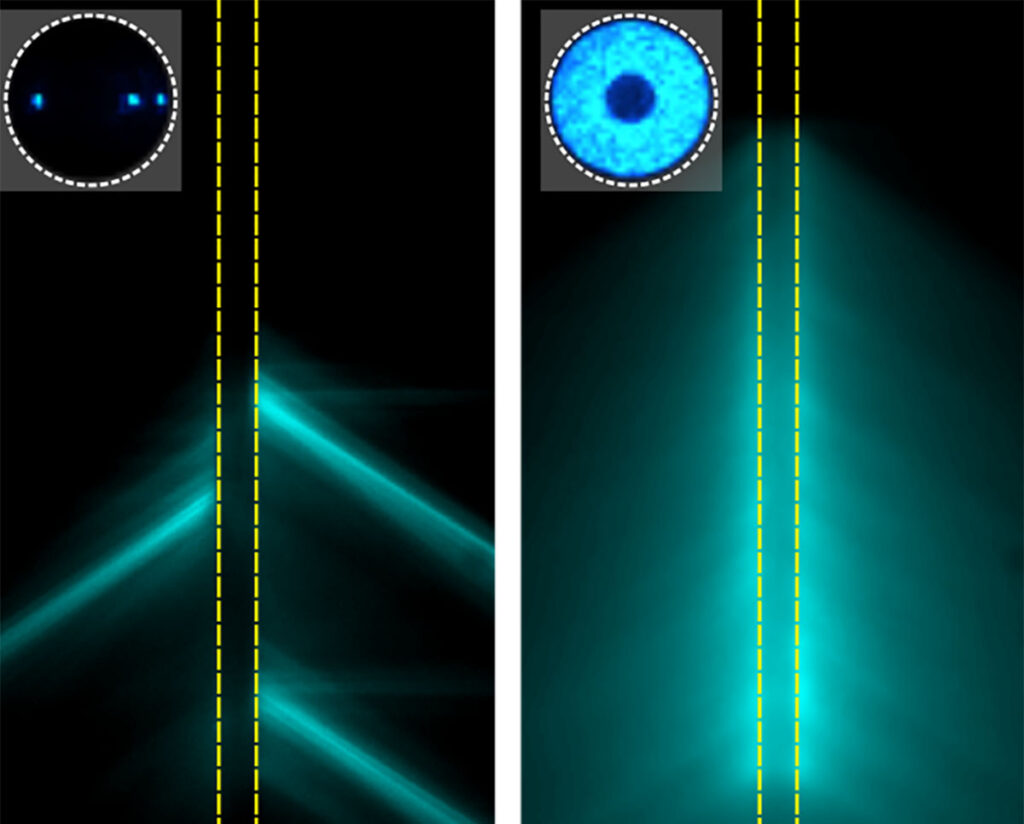
By laser-engraving approximately 1,000 microscopic mirrors into a single optical fiber, WashU engineers and neuroscientists have developed a hair-thin implant that can direct light to multiple deep-brain targets for neural modulation. This image shows how the fiber can be controlled down to a few nodes of light in specific directions, or even the full thousand lit nodes as shown on the right. (Image: Song Hu lab)
<関連情報>
- https://source.washu.edu/2025/11/prime-time-for-fiber-optics-to-take-a-deep-dive-into-brain-circuits/
- https://www.nature.com/articles/s41593-025-02106-x
神経活動をパノラマ的に再構成可能な制御を可能にするレーザーエンジニアリングされたPRIMEファイバー Laser-engineered PRIME fiber for panoramic reconfigurable control of neural activity
Shuo Yang (杨硕),Keran Yang (杨轲然),Quentin Chevy,Adam Kepecs & Song Hu (胡松)
Nature Neuroscience Published:31 October 2025
DOI:https://doi.org/10.1038/s41593-025-02106-x
Abstract
Understanding the neural basis of behavior requires tools to flexibly control neural activity across distributed circuits. Optical methods enable precise, cell-type-specific control, but current fiber-based approaches deliver light to only a few fixed sites, limiting versatility. To address this, we developed ‘panoramically reconfigurable illuminative’ (PRIME), a single-fiber probe with over a thousand light-emitting sites distributed along its length and circumference, enabling panoramic and reconfigurable illumination from a single implant. We equipped a 160-μm multicore fiber with laser-engineered grating light emitters at designated axial and radial positions. By modulating input light patterns, PRIME dynamically switched illumination at 60 Hz among 1,200 sites spanning 5 mm and 360°. By integrating PRIME with high-density recording arrays, including Neuropixels, we demonstrated spatially targeted optogenetic activation alongside simultaneous electrophysiological recording in vivo. In freely moving mice, stimulation at different depths and locations within the superior colliculus evoked distinct defensive behaviors. PRIME’s scalable and reconfigurable light delivery across large volumes offers a powerful platform for optical control of neural circuits across the brain.