2025-12-02 ミュンヘン大学
<関連情報>
- https://www.lmu.de/en/newsroom/news-overview/news/biophysics-pattern-formation-of-protein-pattern-interfaces-8a3213c4.html
- https://www.nature.com/articles/s41567-025-03101-6
有効界面張力から生じるタンパク質パターンの形態とダイナミクス Protein pattern morphology and dynamics emerging from effective interfacial tension
Henrik Weyer,Tobias A. Roth & Erwin Frey
Nature Physics Published:02 December 2025
DOI:https://doi.org/10.1038/s41567-025-03101-6
Abstract
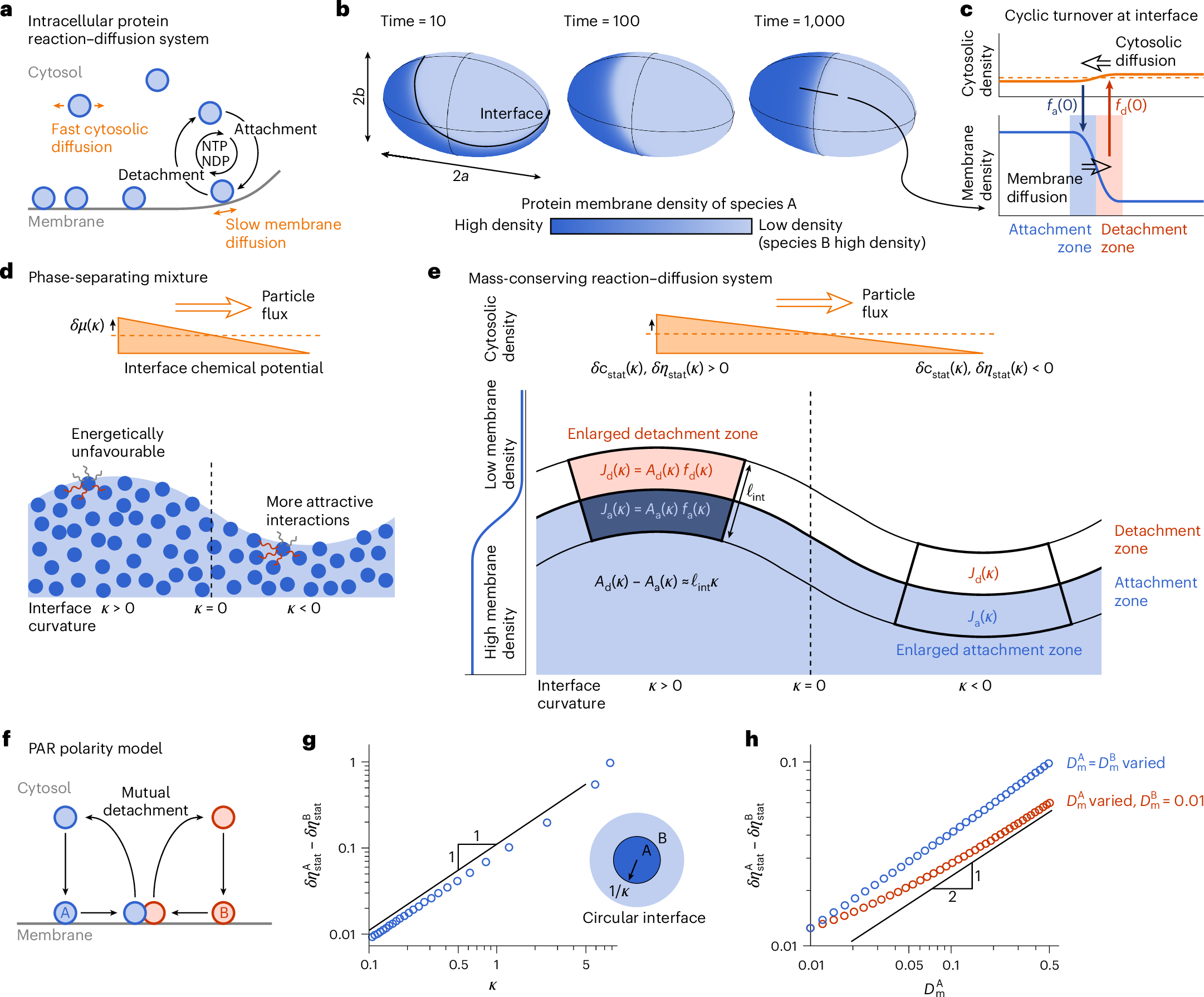
For cellular functions such as division and polarization, protein pattern formation driven by NTPase cycles is a central spatial control strategy. Operating far from equilibrium, no general theory links microscopic reaction networks and parameters to the pattern type and dynamics in these protein systems. Here we discover a generic mechanism giving rise to an effective interfacial tension organizing the macroscopic structure of non-equilibrium steady-state patterns. Namely, maintaining protein-density interfaces by cyclic protein attachment and detachment produces curvature-dependent protein redistribution, which straightens the interface. We develop a non-equilibrium Neumann angle law and Plateau vertex conditions for interface junctions and mesh patterns, thus introducing the concepts of ‘Turing mixtures’ and ‘Turing foams’. In contrast to liquid foams and mixtures, these non-equilibrium patterns can select an intrinsic wavelength by interrupting an equilibrium-like coarsening process. Data from in vitro experiments with the Escherichia coli Min protein system verify the vertex conditions and support the wavelength dynamics. Our study shows how interface laws with correspondence to thermodynamic relations can arise from distinct physical processes in active systems. It allows the design of specific pattern morphologies with potential applications as spatial control strategies in synthetic cells.