2025-12-12 ブラウン大学
<関連情報>
- https://www.brown.edu/news/2025-12-12/bioluminescence-brain-imaging-tool
- https://www.nature.com/articles/s41592-025-02972-0
CaBLAM: 改変されたOplophorus gracilirostrisルシフェラーゼ由来の高コントラスト生物発光 Ca2+指示薬 CaBLAM: a high-contrast bioluminescent Ca2+ indicator derived from an engineered Oplophorus gracilirostris luciferase
Gerard G. Lambert,Emmanuel L. Crespo,Jeremy Murphy,Kevin L. Turner,Emily Gershowitz,Michaela Cunningham,Daniela Boassa,Selena Luong,Dmitrijs Celinskis,Justine J. Allen,Stephanie Venn,Yunlu Zhu,Mürsel Karadas,Jiakun Chen,Roberta Marisca,Hannah Gelnaw,Daniel K. Nguyen,Junru Hu,Brittany N. Sprecher,Maya O. Tree,Richard Orcutt,Daniel Heydari,Aidan B. Bell,Albertina Torreblanca-Zanca,… Nathan C. Shaner
Nature Methods Published:02 December 2025
DOI:https://doi.org/10.1038/s41592-025-02972-0
Abstract
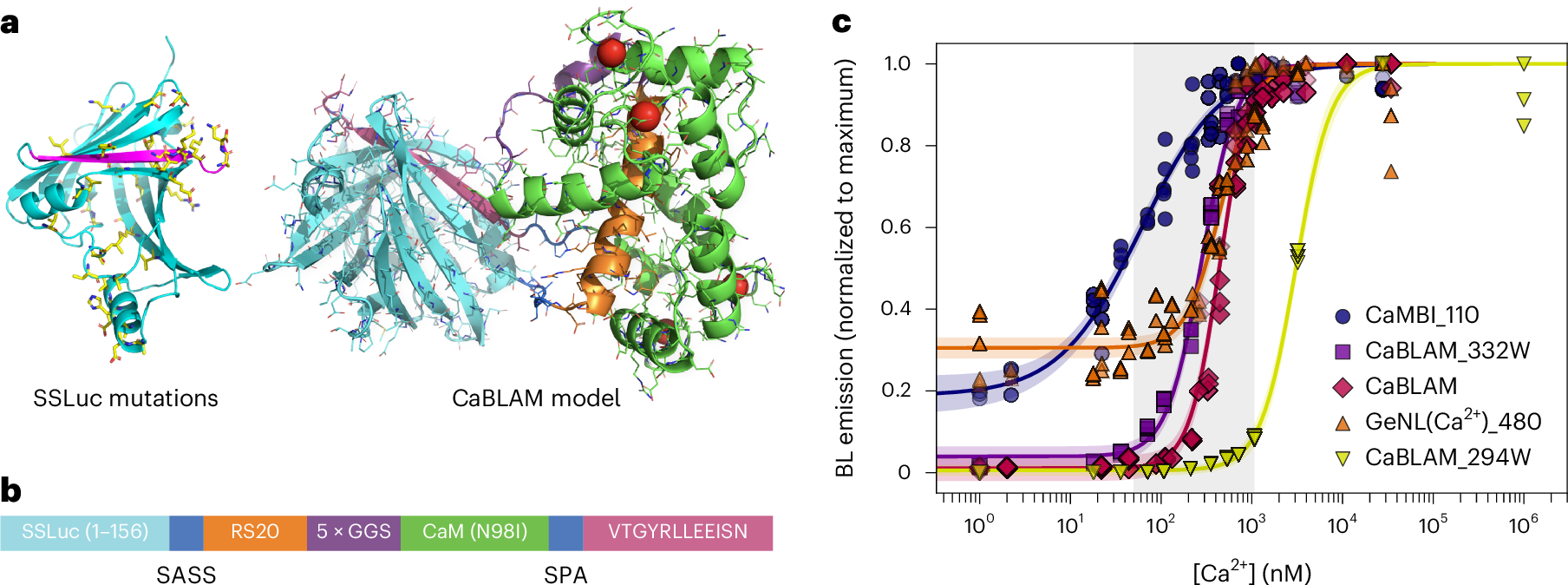
Monitoring intracellular calcium is central to understanding cell signaling across nearly all cell types and organisms. Fluorescent genetically encoded calcium indicators (GECIs) remain the standard tools for in vivo calcium imaging, but require intense excitation light, leading to photobleaching, background autofluorescence and phototoxicity. Bioluminescent GECIs, which generate light enzymatically, eliminate these artifacts but have been constrained by low dynamic range and suboptimal calcium affinities. Here we show that CaBLAM (‘calcium bioluminescence activity monitor’), an engineered bioluminescent calcium indicator, achieves an order-of-magnitude improvement in signal contrast and a tunable affinity matched to physiological cytosolic calcium. CaBLAM enables single-cell and subcellular activity imaging at video frame rates in cultured neurons and sustained imaging over hours in awake, behaving animals. These capabilities establish CaBLAM as a robust and general alternative to fluorescent GECIs, extending calcium imaging to regimes where excitation light is undesirable or infeasible.