2025-12-18 京都大学
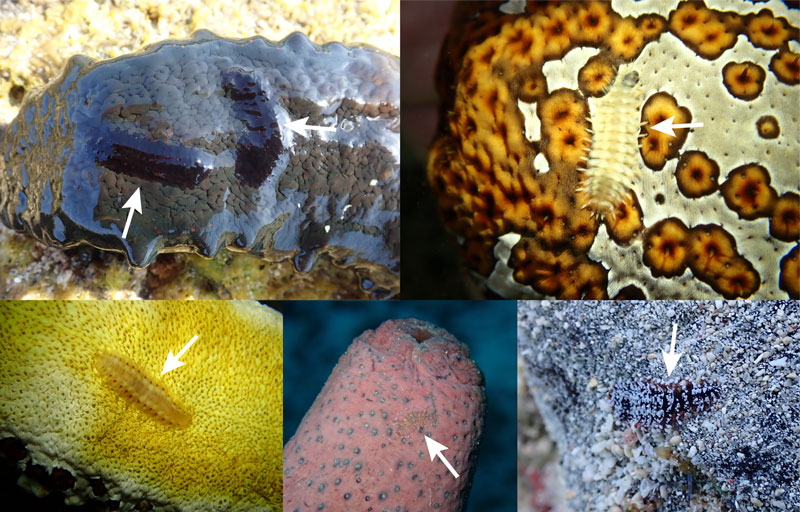
様々なナマコ類に寄生するナマコウロコムシ。全て同種。宿主の体色にあった体色を示す。(Photo credit:後藤龍太郎・杉山高大・Chloé J.L. Fourreau)
<関連情報>
- https://www.kyoto-u.ac.jp/ja/research-news/2025-12-18-0
- https://www.kyoto-u.ac.jp/sites/default/files/2025-12/web_2512_Goto-eb47b00288ef3b5a160f78053a1a1798.pdf
- https://link.springer.com/article/10.1007/s00227-025-04744-y
ナマコ類外部寄生性カイガラムシにおける宿主特異的カモフラージュ:COIおよびゲノムワイドSNPデータを用いた宿主種族仮説の検証 Host specific camouflage in a holothurian-ectoparasitic scale worm: testing the host-race hypothesis using COI and genome-wide SNP data
Takahiro Sugiyama,Genki Kobayashi,Chloé Julie Loïs Fourreau,Kohei Hamamoto,James Davis Reimer,Michitaka Shimomura,Akira Asakura & Ryutaro Goto
Marine Biology Published:10 December 2025
DOI:https://doi.org/10.1007/s00227-025-04744-y
Abstract
Gastrolepidia clavigera (Annelida: Polynoidae) is an ectoparasitic scale worm living on the body surface of holothuroid sea cucumbers in warm shallow seas. This species exhibits variation in its cryptic coloration (e.g., black, light brown, and white), closely matching the body color of each of its host holothurians. However, the mechanism underlying such host-specific camouflage remains unknown. Our hypothesis is that G. clavigera may comprise multiple host-specific genetic lineages (“host races”) corresponding to different color morphs. To test this, we investigated the relationships between color variation and genetic differentiation in G. clavigera populations from the Ryukyu Archipelago, southern Japan. Worms collected from 14 species of holothuroids, six of which are newly recorded as hosts, showed a range of host-specific color morphs, including newly recorded patterns (such as striped). Using mitochondrial COI sequences and genome-wide SNP data, we found no significant genetic differences related to host species or body color. Although SNP analysis revealed two genetic subgroups, these did not correlate with color morphs or host associations. These results suggest that the color variation in G. clavigera represents intraspecific phenotypic plasticity rather than cryptic speciation or host-associated genetic divergence.