2026-02-12 生命創成探究センター
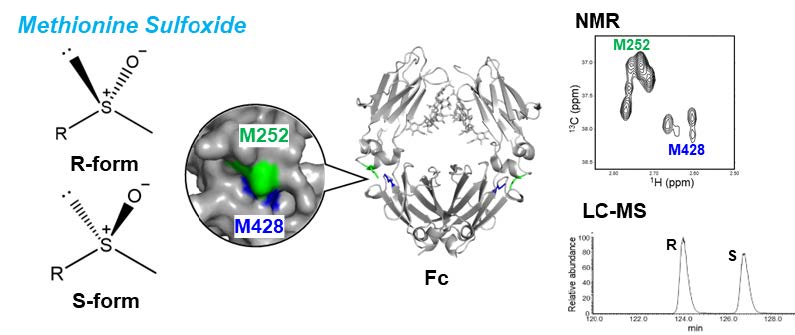
図: 抗体Fc領域におけるメチオニン酸化と⽴体化学
<関連情報>
IgG1 Fc領域におけるメチオニン酸化のNMRおよびLC-MS統合分析による立体化学的および構造的特徴づけ Stereochemical and Structural Characterization of Methionine Oxidation in the IgG1 Fc Region by Integrated NMR and LC-MS Analysis
Maho Yagi-Utsumi,Saeko Yanaka,Noritaka Hashii,Kohei Tomita,Takashi Misawa,Yosuke Demizu,Akiko Ishii-Watabe,and Koichi Kato
Analytical Chemistry Published: February 11, 2026
DOI:https://doi.org/10.1021/acs.analchem.5c06092
Abstract
Monoclonal antibodies are widely used biotherapeutics, whose efficacy and pharmacokinetics critically depend on their structural integrity. Among chemical degradation pathways, methionine oxidation is a particularly important post-translational modification that compromises antibody stability, Fc receptor binding, and thereby FcRn-mediated recycling and FcγR-mediated effector functions. However, the structural consequences of oxidation remain poorly understood, largely due to the subtle and localized nature of the modification. Here, we present an integrated analytical framework combining methyl-based NMR spectroscopy, selective enzymatic reduction, and peptide mapping to resolve methionine oxidation in the Fc region of human IgG1 antibodies at residue- and stereochemical-level resolution. By selectively labeling methionine methyl groups, we monitored oxidation-induced spectral changes in conserved Fc residues Met252 and Met428. Site-directed mutagenesis revealed a mutual influence between these residues, consistent with their spatial proximity at the CH2–CH3 domain interface. Stereospecific reduction with methionine sulfoxide reductase A enabled the assignment of R- and S-isomers, while peptide mapping by liquid chromatography–mass spectrometry corroborated the NMR findings. This combined approach demonstrated that Met252, which is solvent-exposed, is more susceptible to oxidation than buried Met428 and that both residues display stereochemical heterogeneity that modulates local structure. By bridging chemical modifications and higher-order structural perturbations, this integrated framework provides mechanistic insights into how methionine oxidation impairs antibody function. More broadly, it establishes a basis for quality assurance and rational design of therapeutic antibodies with improved stability.