2026-03-09 フランス国立科学研究センター(CNRS)
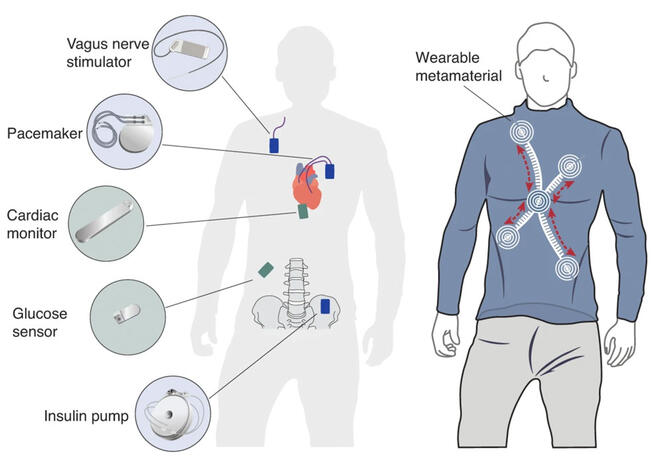
Diagram of an implant-to-implant wireless network at the scale of the human body, interconnected by metamaterial textiles.
<関連情報>
- https://news.cnrs.fr/articles/medical-implants-of-the-future
- https://www.cell.com/cell-reports-physical-science/fulltext/S2666-3864%2825%2900226-7
- https://www.nature.com/articles/s41467-023-39850-2
効率的なワイヤレス埋め込み型バイオエレクトロニクスのための物理的洞察と設計原則 Physical insights and design principles for efficient wireless implantable bioelectronics
Mingxiang Gao ∙ Denys Nikolayev ∙ Zvonimir Sipus ∙ Anja K. Skrivervik
Cell Reports Physical Science Published:June 20, 2025
DOI:https://doi.org/10.1016/j.xcrp.2025.102627
Highlights
- Analytical modeling identifies three key electromagnetic loss mechanisms in the body
- Rapid estimation method identifies optimal operating frequency for wireless implants
- Optimizing source type and encapsulation size maximizes in-body radiation efficiency
- Experiments confirm 5- to 10-fold improvements in wireless implant efficiency
Summary
Implantable bioelectronics require highly efficient wireless connectivity for autonomous operation and closed-loop control, yet power constraints, safety regulations, and data transmission limitations continue to hinder advancements in medical device innovation. This study systematically investigates radiation loss mechanisms and proposes strategies to improve electromagnetic efficiency in wireless implantable systems. Utilizing spherical harmonic analysis, we quantify radiation efficiency and in-body path loss through rigorous closed-form electromagnetic modeling, identifying three primary loss mechanisms. On this basis, we introduce a rapid and accurate estimation technique to optimize the operating frequency, complemented by design principles aimed at augmenting radiation performance for robust wireless links. The proposed strategies, substantiated through comprehensive numerical and experimental validation with realistic implants, demonstrate a potential 5- to 10-fold improvement in implant radiation efficiency or gain, offering significant benefits for early-stage implantable device development.
メタマテリアル繊維によるインプラント間無線ネットワーク Implant-to-implant wireless networking with metamaterial textiles
Xi Tian,Qihang Zeng,Selman A. Kurt,Renee R. Li,Dat T. Nguyen,Ze Xiong,Zhipeng Li,Xin Yang,Xiao Xiao,Changsheng Wu,Benjamin C. K. Tee,Denys Nikolayev,Christopher J. Charles & John S. Ho
Nature Communications Published:19 July 2023
DOI:https://doi.org/10.1038/s41467-023-39850-2
Abstract
Implanted bioelectronic devices can form distributed networks capable of sensing health conditions and delivering therapy throughout the body. Current clinically-used approaches for wireless communication, however, do not support direct networking between implants because of signal losses from absorption and reflection by the body. As a result, existing examples of such networks rely on an external relay device that needs to be periodically recharged and constitutes a single point of failure. Here, we demonstrate direct implant-to-implant wireless networking at the scale of the human body using metamaterial textiles. The textiles facilitate non-radiative propagation of radio-frequency signals along the surface of the body, passively amplifying the received signal strength by more than three orders of magnitude (>30 dB) compared to without the textile. Using a porcine model, we demonstrate closed-loop control of the heart rate by wirelessly networking a loop recorder and a vagus nerve stimulator at more than 40 cm distance. Our work establishes a wireless technology to directly network body-integrated devices for precise and adaptive bioelectronic therapies.