2025-07-01 カリフォルニア大学ロサンゼルス校 (UCLA)
Jun Chen Lab/UCLA
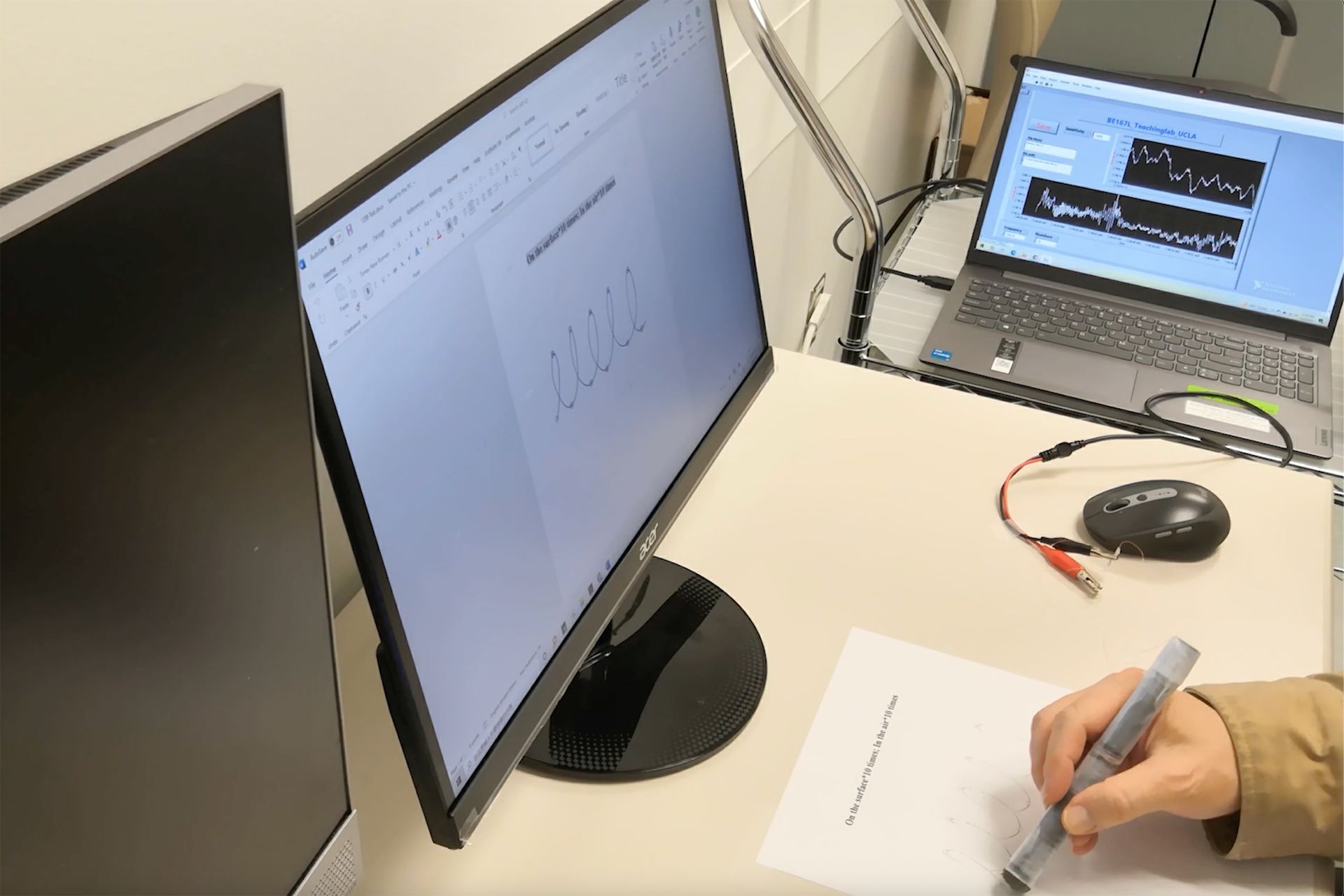
The highly sensitive diagnostic pen features a soft, silicon magnetoelastic tip and ferrofluid ink — a special liquid containing tiny magnetic particles.
<関連情報>
- https://newsroom.ucla.edu/stories/3d-printed-magnetoelastic-smart-pen-diagnose-parkinsons
- https://samueli.ucla.edu/3d-printed-magnetoelastic-smart-pen-may-help-diagnose-parkinsons/
- https://www.nature.com/articles/s44286-025-00219-5
パーキンソン病診断のためのニューラルネットワーク支援によるパーソナライズされた手書き文字解析 Neural network-assisted personalized handwriting analysis for Parkinson’s disease diagnostics
Guorui Chen,Trinny Tat,Yihao Zhou,Zhaoqi Duan,Junkai Zhang,Kamryn Scott,Xun Zhao,Zeyang Liu,Wei Wang,Song Li,Katy A. Cross & Jun Chen
Nature Chemical Engineering Published:02 June 2025
DOI:https://doi.org/10.1038/s44286-025-00219-5
Abstract
Diagnosing Parkinson’s disease (PD) promptly, accessibly and effectively is crucial for improving patient outcomes, yet reaching this goal remains a challenge. Here we developed a diagnostic pen featuring a soft magnetoelastic tip and ferrofluid ink, capable of sensitively and quantitatively converting both on-surface and in-air writing motions into high-fidelity, analyzable signals for self-powered PD diagnostics. The diagnostic pen’s working mechanism is based on the magnetoelastic effect in its magnetoelastic tip and the dynamic movement of the ferrofluid ink. To validate the clinical potential, a pilot human study was conducted, incorporating both patients with PD and healthy participants. The diagnostic pen accurately recorded handwriting signals, and a one-dimensional convolutional neural network-assisted analysis successfully distinguished patients with PD with an average accuracy of 96.22%. Our development of the diagnostic pen represents a low-cost, widely disseminable and reliable technology with the potential to improve PD diagnostics across large populations and resource-limited areas.