2025-07-28 オックスフォード大学
<関連情報>
- https://www.ox.ac.uk/news/2025-07-28-amr-surveillance-project-nigeria-delivers-life-saving-impacts
- https://www.nature.com/articles/s41467-025-62102-4
サンプルを超えて:ナイジェリアの研究者たちの視点から見た多施設共同新生児敗血症研究の影響 Beyond the samples: Nigerian research staff perspectives on a multicentre neonatal sepsis study’s impact
Chinenye Akpulu,Rashida Yakubu,Fatima Tukur,Ashiru H. Yusuf,Aisha Kassim,Aisha Mukaddas,Adeola Adeleye,Fatima Alkali,Augustine O. Maduekwe,Queen Nsude,Vivian Asunugwo,Mary-Joe Okenu,Samuel Yakubu,Lamidi Audu,Mairami Amsa,Fatima Isa Modibbo,Kathryn Thomson,Chioma R. Achi,Kenneth C. Iregbu,Timothy R. Walsh & Kirsty Sands
Nature Communications Published:22 July 2025
DOI:https://doi.org/10.1038/s41467-025-62102-4
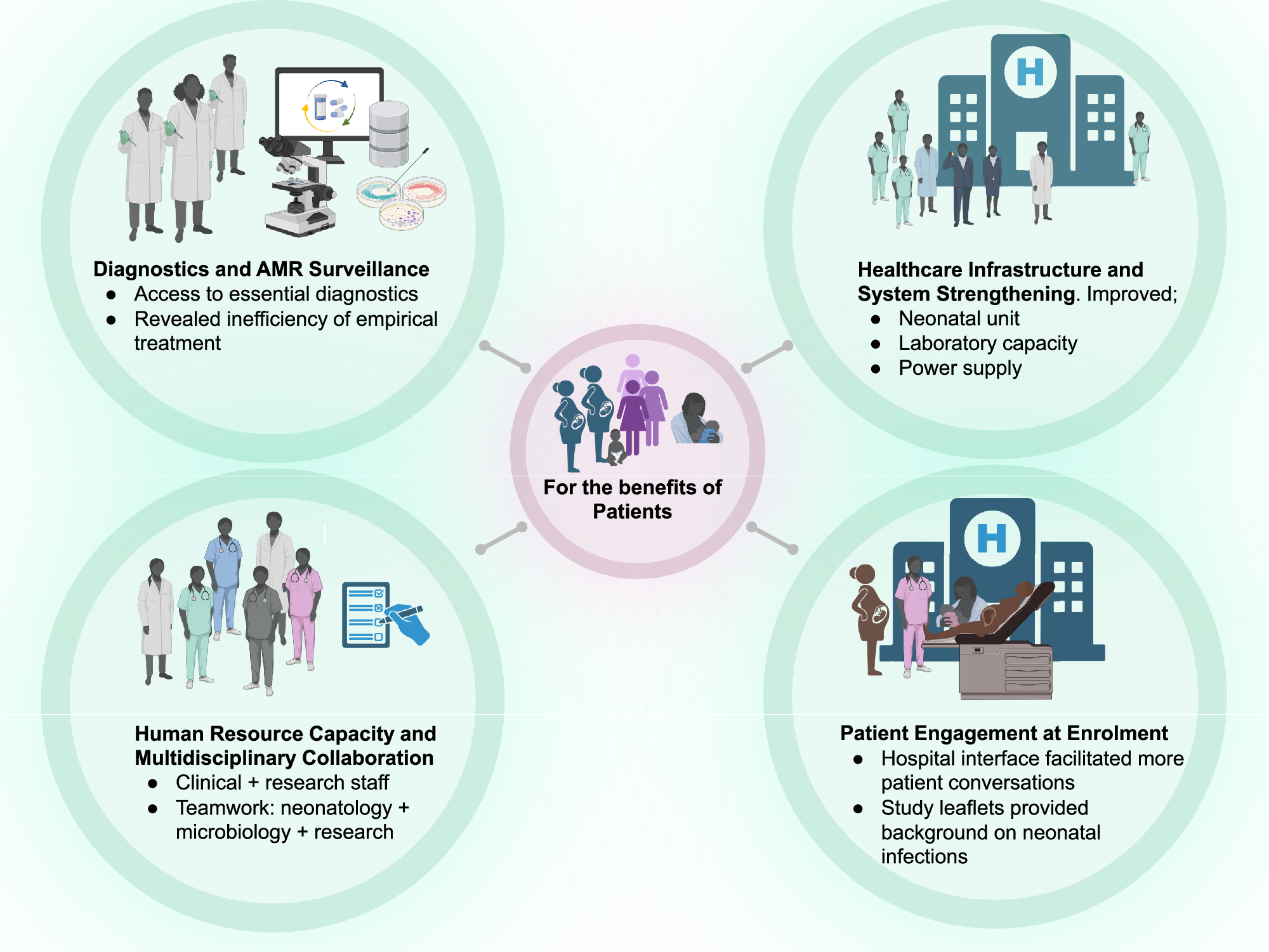
Drawing on experiences of Nigerian healthcare staff in a multi-centre international study, we describe insights into capacity strengthening, patients’ engagement, and discuss long-term challenges in sustaining outcomes after project funding ends.
Healthcare challenges in Nigeria and neonatal sepsis research
Nigeria is the most populated country in Africa, with over 230 million people1 divided into 36 states across six geopolitical zones. Nigeria’s healthcare system is chronically underfunded and faces persistent shortages in healthcare professionals. Limited financial protection mechanisms leave much of the population reliant on out-of-pocket payments for healthcare2. Northern Nigeria, accounting for ~54% of the population, has some of the country’s worst healthcare indicators, particularly maternal, newborn, and infant mortality3. Premature birth remains the leading cause of neonatal mortality, alongside birth complications and neonatal infections4 with 27 neonatal deaths per 1000 live births reported in 20224. Documented neonatal sepsis remains alarmingly high with substantial regional variation5,6,7.