2025-08-04 中国科学院(CAS)
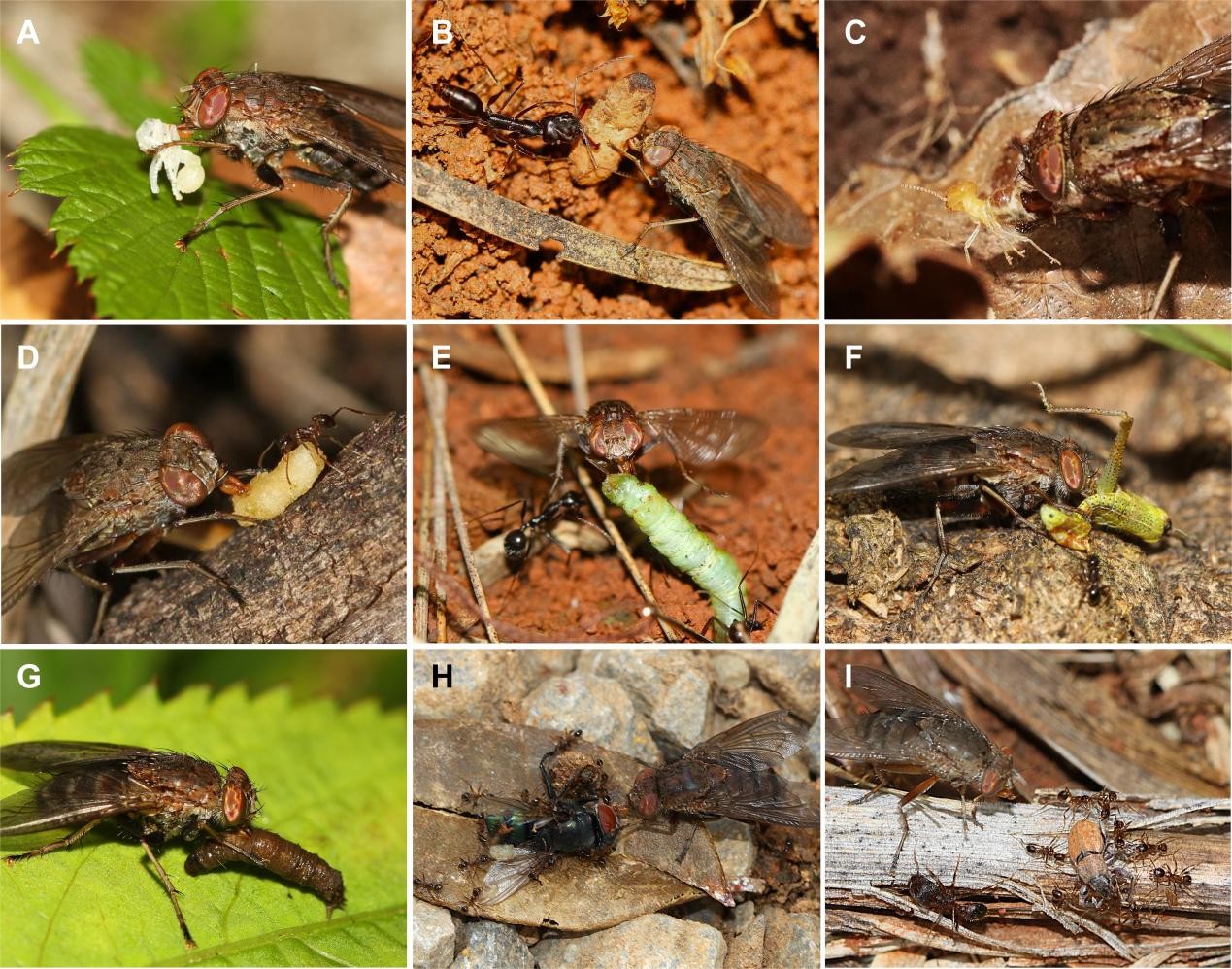
Bengalia flies robbing food or offspring transported by ants: larvae and pupae of ants (A&B), termite (C), breadcrumbs (D), and insects from Lepidoptera, Orthoptera, Diptera, Coleoptera (E-I). (Image by KIB)
<関連情報>
- https://english.cas.cn/newsroom/research_news/life/202508/t20250805_1049210.shtml
- https://www.cell.com/current-biology/abstract/S0960-9822(25)00665-7
kleptoparasitic fliesによる種子の散布 Seed dispersal by kleptoparasitic flies
Yu-Long Yu ∙ Guillaume Chomicki ∙ Gao Chen
Current Biology Published:July 21, 2025
DOI:https://doi.org/10.1016/j.cub.2025.05.049
Summary
Seed dispersal is critical for plant reproduction, and plays a key role in shaping ecosystems1. Most seed plants are animal dispersed1, largely by vertebrates — invertebrate-mediated dispersal is rarer and underexplored, apart from seed dispersal by ants (myrmecochory), which disperse seeds of over 11,000 species2. Rare instances of dispersal by other invertebrates, such as wasps, wetas, and beetles, have been reported3,4,5. Despite their global distribution and diversity, flies (Diptera) have never been reported as seed dispersers. Among Diptera, kleptoparasitic flies — notably the genus Bengalia (Calliphoridae) — rob food and offspring from ants6,7,8. Given the overlap in distribution between Bengalia flies and ant-dispersed plants, it is plausible that the flies interact with seed-dispersing ants, but this remains untested. Here, we report the first evidence of seed dispersal by flies.