2025-08-15 カーディフ大学
<関連情報>
- https://www.cardiff.ac.uk/news/view/2930618-scientists-discover-eight-new-schizophrenia-genes
- https://www.nature.com/articles/s41467-025-62429-y
全エクソームシーケンス解析により統合失調症のリスク遺伝子が同定された Whole-exome sequencing analysis identifies risk genes for schizophrenia
Sophie L. Chick,Peter Holmans,Darren Cameron,Detelina Grozeva,Rebecca Sims,Julie Williams,Nicholas J. Bray,Michael J. Owen,Michael C. O’Donovan,James T. R. Walters & Elliott Rees
Nature Communications Published:02 August 2025
DOI:https://doi.org/10.1038/s41467-025-62429-y
Abstract
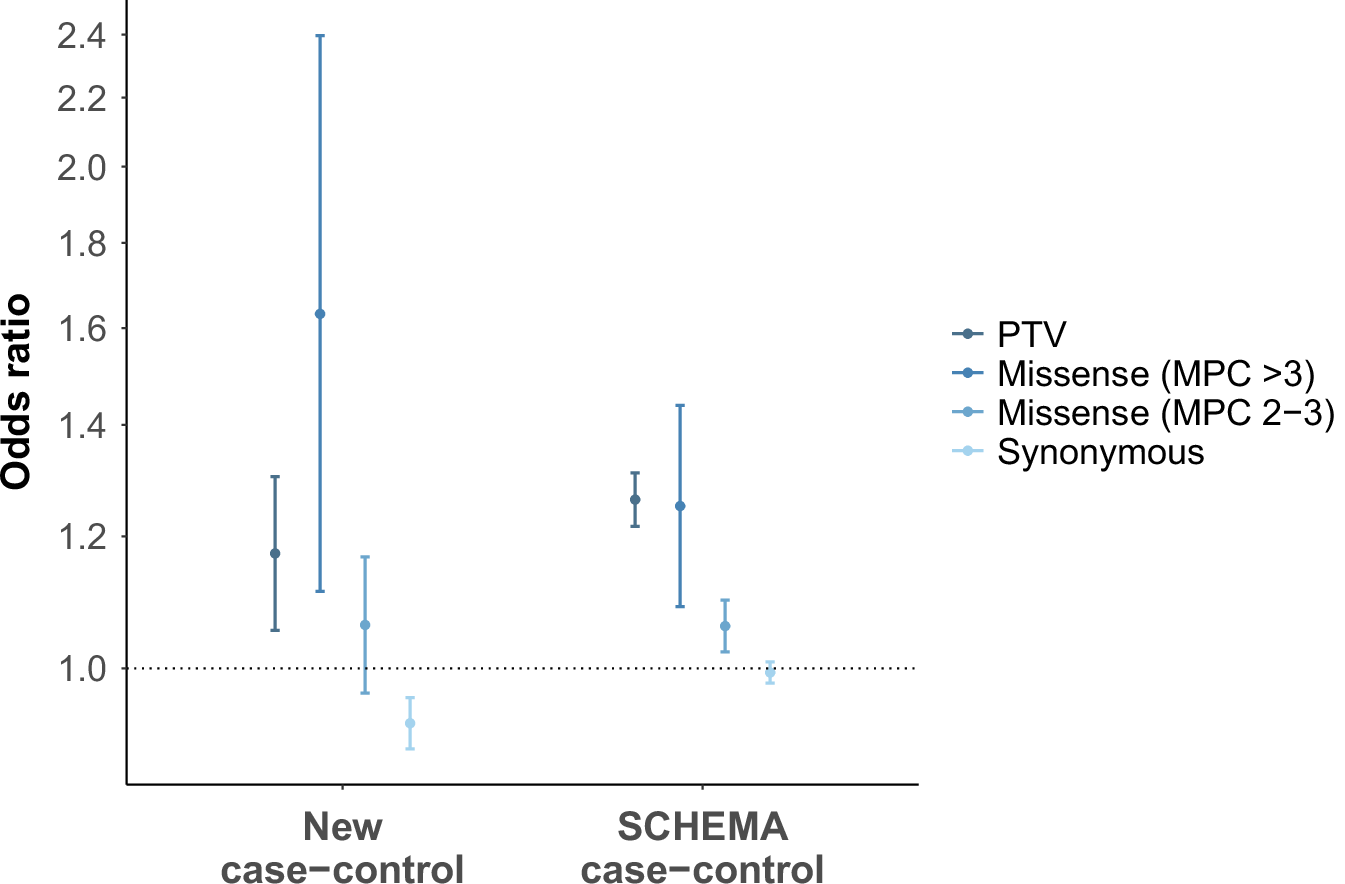
Rare coding variants across many genes contribute to schizophrenia liability, but they have only been implicated in 12 genes at exome-wide levels of significance. To increase power for gene discovery, we analyse exome-sequencing data for rare coding variants in a new sample of 4650 schizophrenia cases and 5719 controls, and combine these with published sequencing data for a total of 28,898 cases, 103,041 controls and 3444 proband-parent trios. We identify associations for STAG1 and ZNF136 at exome-wide significance, genes that were previously implicated in schizophrenia by the SCHEMA study at a false discovery rate of 5%. We also find associations at a false discovery rate of 5% for six genes that did not pass this statistical threshold in the SCHEMA study (SLC6A1, PCLO, ZMYND11, BSCL2, KLC1 and CGREF1). Among these genes, SLC6A1 and KLC1 are associated with damaging missense variants alone. STAG1, SLC6A1, ZMYND11 and CGREF1 are also enriched for rare coding variants in other developmental and psychiatric disorders. Moreover, STAG1 and KLC1 have fine-mapped common variant signals in schizophrenia. These findings provide insights into the neurobiology of schizophrenia, including further evidence suggesting an aetiological role for disrupted chromatin organisation.