
2025-08-26 マウントサイナイ医療システム(MSHS)
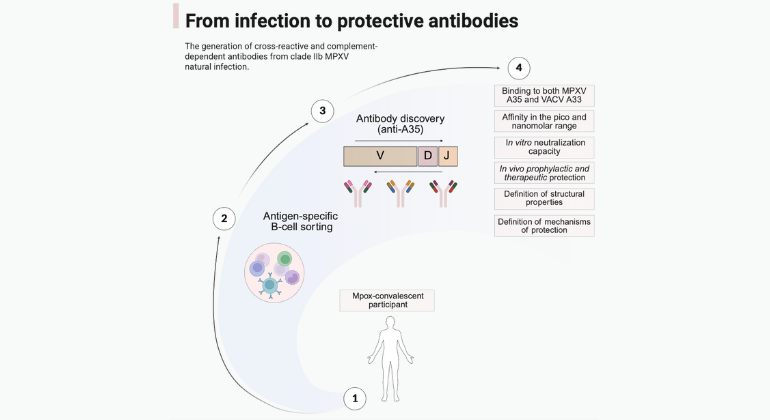 Mount Sinai scientists identified antibodies from a recovered mpox patient that specifically recognize the viral protein A35. These antibodies not only neutralize the virus and protect animal models from disease but also mirror protective immune responses in humans, establishing A35 as a key target for future antiviral strategies.
<関連情報>
- https://www.mountsinai.org/about/newsroom/2025/mount-sinai-scientists-identify-three-potent-human-antibodies-against-mpox-paving-the-way-for-new-protective-therapies
- https://www.cell.com/cell/fulltext/S0092-8674(25)00918-3
A35を標的とするヒトモノクローナル抗体はmpoxによる死亡を防止する Human monoclonal antibodies targeting A35 protect from death caused by mpox
Raianna F. Fantin, ∙ Meng Yuan ∙ Seok-Chan Park, ∙ … ∙ Ian A. Wilson, ∙ Bernard Moss ∙ Camila H. Coelho
Cell Published:August 26, 2025
DOI:https://doi.org/10.1016/j.cell.2025.08.004
Highlights
- A35 mAbs bind MPXV and VACV and prevent death in mouse models
- The mAbs bind a highly conserved poxvirus epitope within the MPXV A35 dimer groove
- A35 mAbs neutralize orthopoxviruses via Fc-dependent and independent mechanisms
- A35-competing mAbs in mpox-convalescent human sera link to better clinical outcomes
Summary
The 2022 mpox outbreak highlighted the serious threat of monkeypox virus (MPXV), yet effective treatments are lacking. From an mpox-convalescent individual, we identified three high-affinity human monoclonal antibodies (mAbs) (named EV35-2, EV35-6, and EV35-7) that target the A35 protein in MPXV. These antibodies block viral spread in vitro and protect mice against lethal MPXV and vaccinia virus infection via both Fc-dependent and independent mechanisms. Levels of serum antibodies targeting the same epitopes are increased in mpox-convalescent humans, and higher levels of these antibodies in the sera are linked to shorter symptom duration and no hospitalization. Systems-level multivariate analysis indicated that mpox-convalescent serum antibodies targeting the same epitopic region as these three mAbs may function cooperatively, with additive associations to clinical protection. Two of the antibodies use a conserved IGHD2-21-encoded CxGGDCx motif in their CDRH3 region to bind a highly conserved poxvirus epitope. These findings establish A35 as a critical therapeutic target and highlight A35-specific mAbs as promising candidates for next-generation orthopoxvirus treatments.

