2025-08-28 早稲田大学
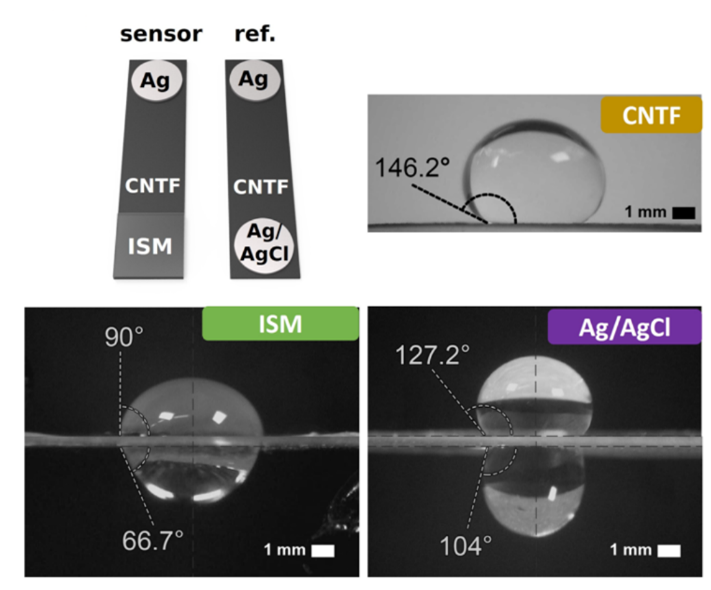
図1:イオン選択膜(ISM)電気化学センサーと参照電極は、カーボンナノチューブフォレスト(CNTF)スポンジ上に構築されています。水滴接触角の測定により、水との相互作用の違いが観察できます。CNTFは超疎水性を示し、Ag/AgCl対電極は中程度の接着性を示し、ISMは低い接着性を示しています。本研究では、ISMに微細構造を導入することで接着性の向上を目指しています。
<関連情報>
イオン選択性膜における汗付着性向上のための生体模倣マイクロテクスチャリング Bioinspired Microtexturing for Enhanced Sweat Adhesion in Ion-Selective Membranes
Marc Josep Montagut Marques, Takayuki Masuji, Mohamed Adel, Ahmed M. R. Fath El-Bab, […] , and Shinjiro Umezu
Cyborg and Bionic Systems Published:5 Aug 2025
DOI:https://doi.org/10.34133/cbsystems.0337
Abstract
Advancements in health wearable technology hold the potential to prevent critical health issues such as hyponatremia and other hydration-related conditions often triggered by intense physical activities. Approaches to address this issue include the development of thin-film wearable sensors incorporating carbon nanotubes (CNTs), which offer scalability, lightweight design, and exceptional electrical properties. CNT paper serves as an ideal substrate for electrochemical sensors like ion-selective membranes (ISMs), enabling effective on-skin electrolyte monitoring. However, current on-skin devices often face limitations in maintaining performance during human motion. This study introduces a bioinspired surface texturing technique that mimics the microstructures of rose petals to enhance wettability, self-cleaning, and ISM sensitivity. By replicating the mechanical properties of the surface texture found on rose petals, the newly developed ISM achieves accurate measurements across a 2-mm air gap, offering an improved interfacing solution that promotes better sweat recirculation and comfort. This advancement overcomes the constraints of traditional sensors, paving the way for more reliable and effective noninvasive health monitoring in real-world conditions.