2025-09-08 ニューヨーク大学 (NYU)
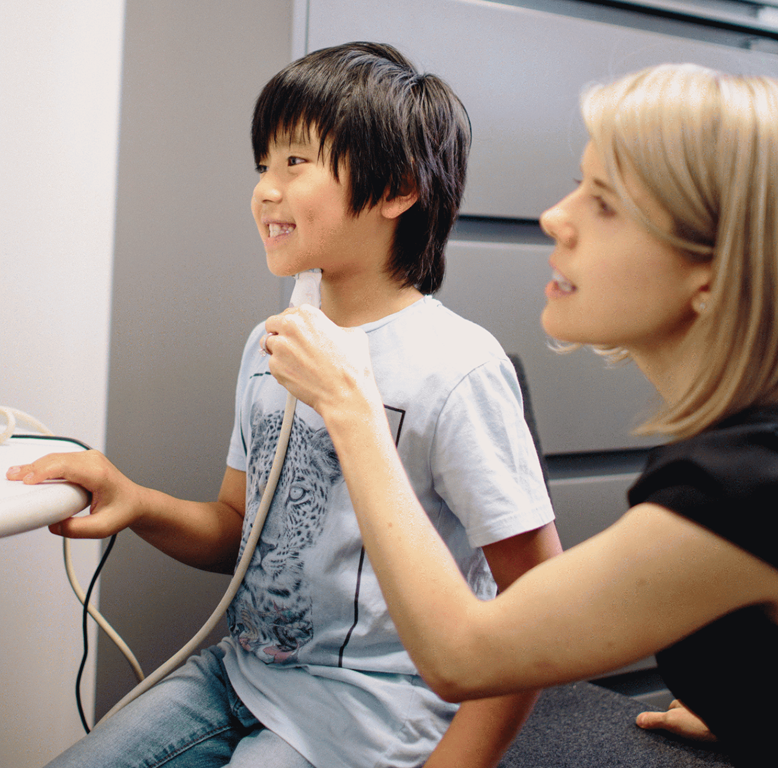
Tara McAllister (right) holds an ultrasound probe under a child’s chin
<関連情報>
- https://www.nyu.edu/about/news-publications/news/2025/september/-children-receiving-biofeedback-speech-therapy-improved-faster-t.html
- https://pubs.asha.org/doi/10.1044/2025_JSLHR-24-00909
残存性発音障害に対するバイオフィードバック療法は運動ベース治療よりロティック獲得が迅速:無作為化比較試験の主要結果 Rhotic Acquisition Is More Rapid in Biofeedback Than Motor-Based Treatment for Residual Speech Sound Disorder: Primary Outcome of a Randomized Controlled Trial
Tara McAllister, Jonathan L. Preston, Nina R. Benway, Jennifer Hill, Marcela P. Lara, Megan C. Leece, Wendy Liang, and Elaine R. Hitchcock
Journal of Speech, Language, and Hearing Research Published:8 September 2025
DOI:https://doi.org/10.1044/2025_JSLHR-24-00909
Abstract
Purpose:
Residual speech sound disorder (RSSD) is a high-prevalence condition that can limit children’s academic and social participation, with negative consequences for overall well-being. Previous studies have described visual biofeedback as a promising option for RSSD, but results have been inconclusive due to study design limitations and small sample sizes.
Method:
In a preregistered randomized controlled trial, 108 children aged 9–15 years with RSSD affecting American English /ɹ/ were randomly assigned to receive treatment incorporating visual biofeedback (subdivided into ultrasound and visual-acoustic types) or a comparison condition of motor-based treatment consistent with current best practices in speech therapy. An acoustic measure (the distance between the second and third formants, which is smaller in perceptually accurate /ɹ/) was used to quantify progress in the first three sessions of treatment in participants’ assigned condition. The focus on the early stages of treatment was grounded in principles of motor learning: As a type of knowledge of performance feedback, biofeedback is expected to have its greatest impact during initial acquisition of a new speech-motor plan.
Results:
A linear mixed-effects regression model revealed a statistically significant interaction between treatment type and session: While both groups made progress over time, the rate of progress was significantly faster in the biofeedback condition compared to motor-based treatment. No statistically significant difference was observed between the ultrasound and visual-acoustic types of biofeedback.
Discussion:
This large-scale randomized controlled trial supports previous small-scale research in finding that biofeedback can help children with RSSD acquire American English /ɹ/. A companion study will compare participants’ generalization learning after the end of all treatment.
Supplemental Material:
- https://doi.org/10.23641/asha.29971501