2025-10-01 カリフォルニア工科大学 (Caltech)
Web要約 の発言:
<関連情報>
- https://www.caltech.edu/about/news/heat-rechargeable-design-powers-nanoscale-molecular-machines
- https://www.nature.com/articles/s41586-025-09570-2
DNA論理回路とニューラルネットワークにおける熱充電可能な計算 Heat-rechargeable computation in DNA logic circuits and neural networks
Tianqi Song & Lulu Qian
Nature Published:01 October 2025
DOI:https://doi.org/10.1038/s41586-025-09570-2
Abstract
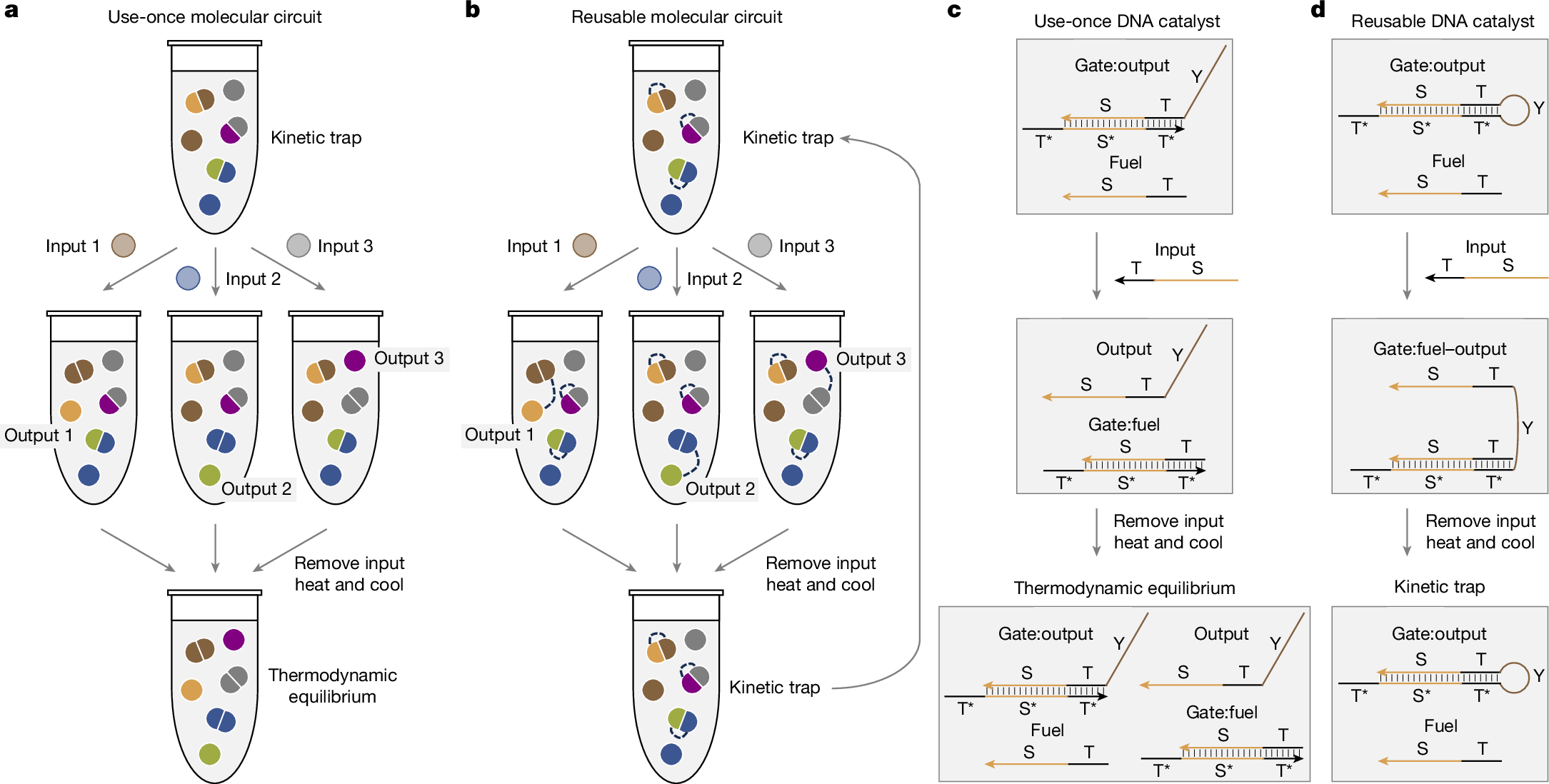
Metabolism enables life to sustain dynamics and to repeatedly interact with the environment by storing and consuming chemical energy. A major challenge for artificial molecular machines is to find a universal energy source akin to ATP for biological organisms and electricity for electromechanical machines. More than 20 years ago, DNA was first used as fuel to drive nanomechanical devices1,2 and catalytic reactions3. However, each system requires distinct fuel sequences, preventing DNA alone from becoming a universal energy source. Despite extensive efforts4, we still lack an ATP-like or electricity-like power supply to sustain diverse molecular machines. Here we show that heat can restore enzyme-free DNA circuits from equilibrium to out-of-equilibrium states. During heating and cooling, nucleic acids with strong secondary structures reach kinetically trapped states5,6, providing energy for subsequent computation. We demonstrate that complex logic circuits and neural networks, involving more than 200 distinct molecular species, can respond to a temperature ramp and recharge within minutes, allowing at least 16 rounds of computation with varying sequential inputs. Our strategy enables diverse systems to be powered by the same energy source without problematic waste build-up, thereby ensuring consistent performance over time. This scalable approach supports the sustained operation of enzyme-free molecular circuits and opens opportunities for advanced autonomous behaviours, such as iterative computation and unsupervised learning in artificial chemical systems.