2025-10-06 ジョンズ・ホプキンス大学
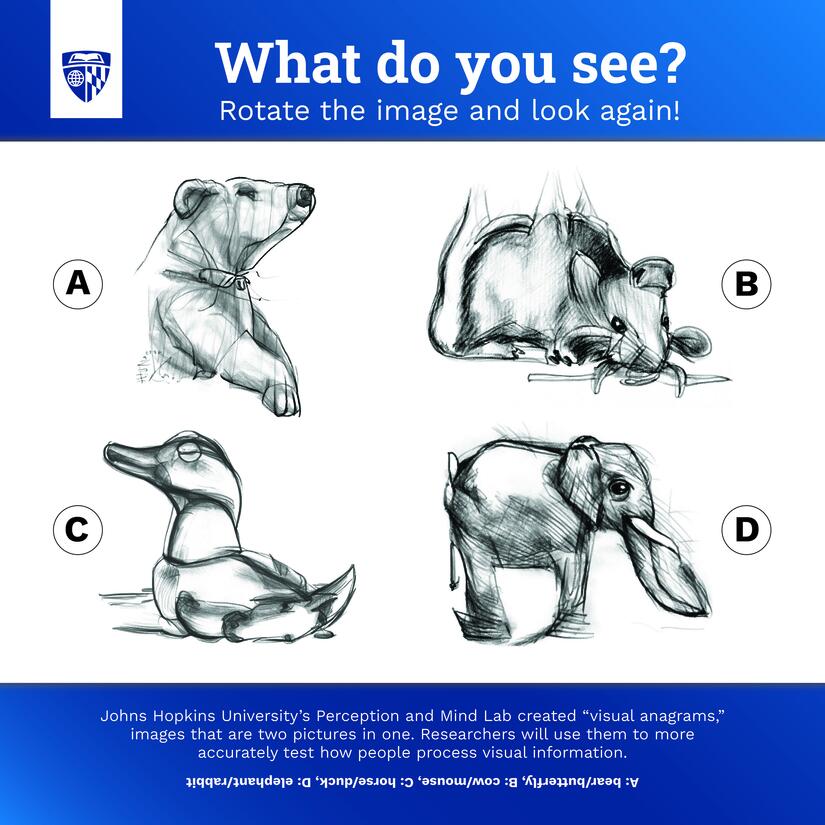
Image credit: Khamar Hopkins / Johns Hopkins University
<関連情報>
- https://hub.jhu.edu/2025/10/06/visual-anagrams/
- https://www.cell.com/current-biology/abstract/S0960-9822(25)01102-9
視覚的なアナグラムは「同一の」刺激による高レベルの効果を明らかにする Visual anagrams reveal high-level effects with ‘identical’ stimuli
Tal Boger ∙ Chaz Firestone
Current Biology Published:October 06, 2025
DOI:https://doi.org/10.1016/j.cub.2025.08.036
Summary
A fundamental question in psychology and neuroscience concerns how the mind represents not only lower-level stimulus features such as luminance, contrast, or spatial frequency, but also richer, higher-level properties such as animacy, emotion, or real-world size. Numerous findings suggest that such high-level properties are encoded automatically1,2, engage visual attention3,4, and organize neural responses5,6. However, a critical challenge arises when interpreting such findings: High-level categories systematically covary with lower-level features, such that effects attributed to high-level properties may instead be driven by their lower-level covariates. Can this challenge be overcome? Here, we introduce a novel approach by leveraging ‘visual anagrams’ — a diffusion-based technique for generating images whose interpretations change radically with orientation, such as a cow when upright and a mouse when inverted7. Using real-world size as a case study, we generated anagrams depicting a canonically large object in one orientation and a canonically small object in another, and placed them in classic experimental paradigms. Five experiments revealed that many (but not all) effects of real-world size persisted under such conditions. Together, our findings address a longstanding challenge in perception research and establish a broadly applicable tool for psychology and neuroscience.