2025-10-27 タフツ大学
<関連情報>
- https://now.tufts.edu/2025/10/27/ai-pt-how-one-professor-leading-charge
- https://www.nature.com/articles/s41467-025-63019-8
- https://www.sciencedirect.com/science/article/abs/pii/S1466853X19304997
スパース観測からのトランスフォーマーベースの機械学習推論による既知と未知のダイナミクスの橋渡し Bridging known and unknown dynamics by transformer-based machine-learning inference from sparse observations
Zheng-Meng Zhai,Benjamin D. Stern & Ying-Cheng Lai
Nature Communications Published:28 August 2025
DOI:https://doi.org/10.1038/s41467-025-63019-8
Abstract
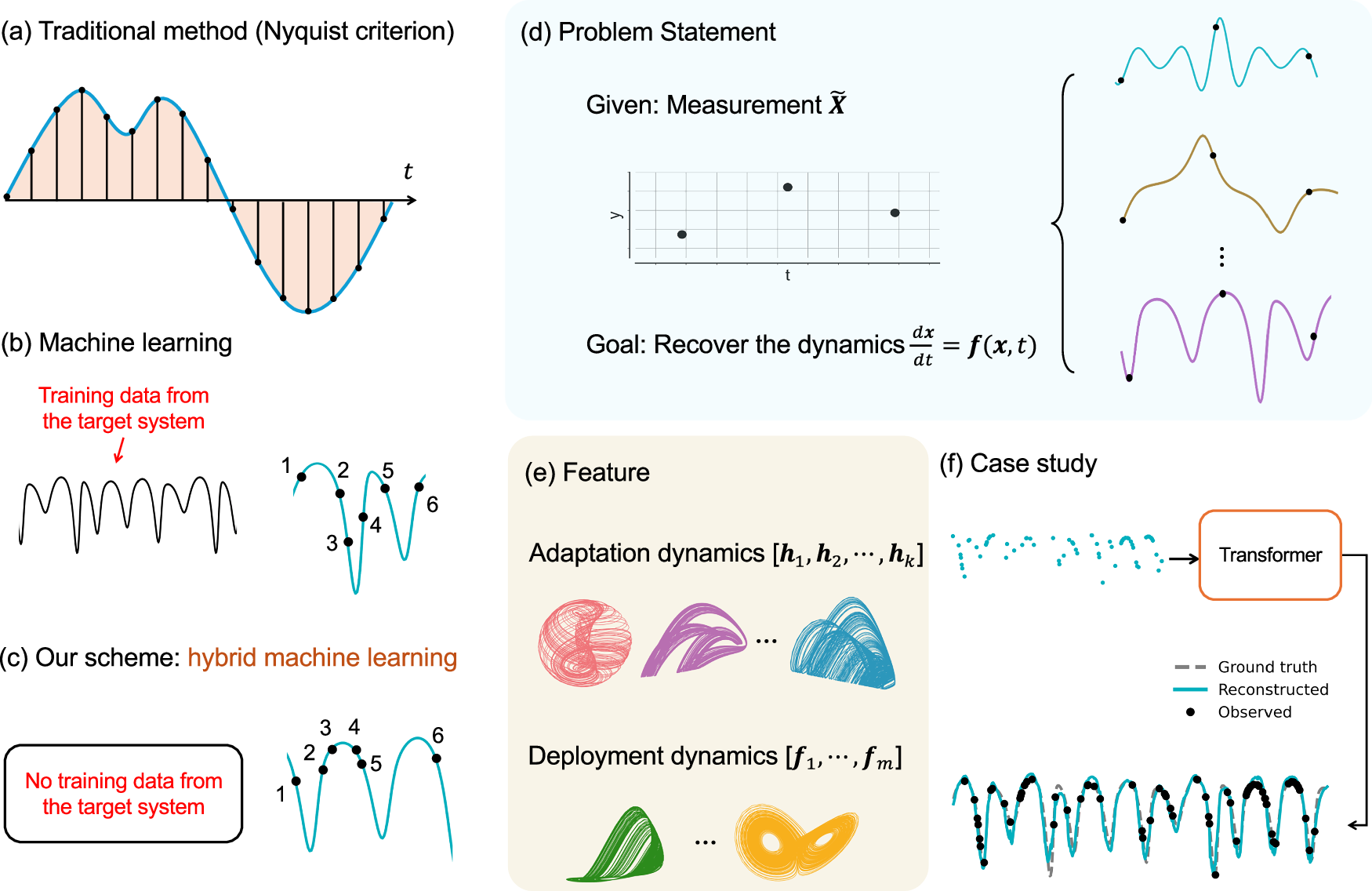
In applications, an anticipated issue is where the system of interest has never been encountered before and sparse observations can be made only once. Can the dynamics be faithfully reconstructed? We address this challenge by developing a hybrid transformer and reservoir-computing scheme. The transformer is trained without using data from the target system, but with essentially unlimited synthetic data from known chaotic systems. The trained transformer is then tested with the sparse data from the target system, and its output is further fed into a reservoir computer for predicting its long-term dynamics or the attractor. The proposed hybrid machine-learning framework is tested using various prototypical nonlinear systems, demonstrating that the dynamics can be faithfully reconstructed from reasonably sparse data. The framework provides a paradigm of reconstructing complex and nonlinear dynamics in the situation where training data do not exist and the observations are random and sparse.
非線形システムとしての傷害予測 Injury prediction as a non-linear system
Benjamin D. Stern, Eric J. Hegedus, Ying-Cheng Lai
Physical Therapy in Sport Available online: 8 November 2019
DOI:https://doi.org/10.1016/j.ptsp.2019.10.010
Section snippets
Background- The injury prediction debate
The purpose of screening in sports is to examine large populations of asymptomatic individuals aiming to predict who is at greatest risk of sustaining an injury. Ideally, once at-risk athletes are identified, scientists, clinicians, and coaches would address variables associated with risk by using behavior modification, changing training regime, or improving movement strategies (mitigate risk). This approach is logical and would be of great benefit to active individuals everywhere, but sports
Athletes, like hurricanes are nonlinear, dynamic systems
Hurricanes and athletes are both nonlinear dynamic systems. The web of determinants for a hurricane includes wind speed, wind direction, humidity, and sea surface temperature, among others (Brennan & Majumdar, 2011). Because of the continuous-time nature of the system, it is necessary to collect data as frequently as possible. In fact, existing data-based methods to analyze nonlinear dynamical systems all require continuously sampled time series data to enable the intrinsic properties of the
Is there any evidence resistance to injury is a dynamic system?
There is some support for viewing the athlete’s resistance to injury as a dynamic system. Strength, power, and markers of muscle damage can vary dramatically throughout a season (Kraemer, Looney, Martin, & etal, 2013; McMaster, Gill, Cronin, & McGuigan, 2013). Physiological components of human performance can vary over the course of a single day (Ammar, Chtourou, & Souissi, 2017; Atkinson & Reilly, 1996; Kafkas, Taskiran, Sahin Kafkas, & etal, 2016). There is inherent uncertainty of the
Suggested changes in injury risk assessment
Studies examining the predictive value of various tests and measures on injury risk generally collect data from the screen just prior to the start of the sports season and injury data is then collated and analyzed at some point after the season (Hegedus, McDonough, & Bleakley, 2016; van Dyk, Bahr, Whiteley, & etal, 2016; Warren, Smith, & Chimera, 2015). Upon analyzing the data, positive or negative associations between injuries and the screening results are assumed. However, the time interval
Key points
- Athletes and resistance to injury, like hurricanes, represent a dynamic system.
- Prediction of injury methodology must improve if we are to capture meaningful relationships among variables and between variables and injury in a non-linear system, that evolves continuously over time.
- More frequent and a broader sampling of the athlete’s web of injury determinants is required if we are to predict and modify injury risk.