2025-10-30 ヒューストン大学(UH)
<関連情報>
- https://www.uh.edu/news-events/stories/2025/october/10302025-singh-diabetic-ketoacidosis.php
- https://www.embopress.org/doi/full/10.1038/s44319-025-00578-3
筋肉特異的MEF2Dα2アイソフォームは、マウスの筋肉ケトーシスと走行能力を促進する The muscle specific MEF2Dα2 isoform promotes muscle ketolysis and running capacity in mice
Sushil Kumar, Xuan Ji, Hina Iqbal, Xiangnan Guan, Brittany Mis, Devanshi Dave, Suresh Kumar, Jacob Besler, Ranjan Dash, Zheng Xia, and Ravi K Singh
EMBO Press Published:16 September 2025
DOI:https://doi.org/10.1038/s44319-025-00578-3
Abstract
During prolonged starvation and exhaustive exercise, when there is low availability of carbohydrates, the liver breaks down fatty acids to generate ketone bodies, which are utilized by peripheral tissues as an alternative fuel source. The transcription factor MEF2D undergoes regulated alternative splicing in the postnatal period to produce a highly conserved, muscle specific MEF2Dα2 protein isoform. Here, we discover that compared to WT mice, MEF2Dα2 exon knockout (Eko) mice display reduced running capacity and muscle expression of all three ketolytic enzymes: BDH1, OXCT1, and ACAT1. MEF2Dα2 Eko mice consistently show increased blood ketone body levels in a tolerance test, after exercise, and when fed a ketogenic diet. Lastly, using mitochondria isolated from skeletal muscle, Eko mice show reduced ketone body utilization compared to WT mice. Collectively, our findings identify a new role for the MEF2Dα2 protein isoform in regulating skeletal muscle ketone body oxidation, exercise capacity, and systemic ketone body levels.
Synopsis
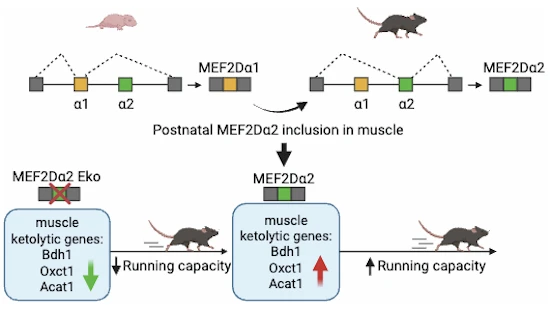
The muscle specific MEF2Dα2 isoform is produced by regulated postnatal alternative splicing. Deletion of this exon in mice causes reduced running capacity and muscle ketolytic gene expression, leading to increased blood ketone body levels.
- The MEF2Dα2 Eko mice show reduced running capacity.
- Reduced muscle expression of BDH1, OCXT1, and ACAT1 in MEF2Dα2 Eko mice.
- Increased blood ketone bodies in MEF2Dα2 Eko mice after exercise, feeding of a high fat ketogenic diet, and in a tolerance test.
- MEF2D binds to the gene loci of all three ketolytic genes.