2025-11-17 コロンビア大学
<関連情報>
- https://news.climate.columbia.edu/2025/11/17/arsenic-chronic-illness-bangladesh/
- https://jamanetwork.com/journals/jama/fullarticle/2841553
ヒ素曝露の低減と慢性疾患による死亡率 Arsenic Exposure Reduction and Chronic Disease Mortality
Fen Wu, PhD; Alexander van Geen, PhD; Joseph Graziano, PhD;et al
Journal of the American Medical Association Published:November 17, 2025
DOI:10.1001/jama.2025.19161
Key Points
Question Is reduced arsenic exposure associated with reduced chronic disease mortality?
Findings In this 20-year prospective cohort study of 11 746 adults in Bangladesh, participants with greater reductions in urinary arsenic had significantly lower mortality from chronic diseases, including cancer and cardiovascular disease, compared with those with persistently high exposure. Participants with increasing arsenic levels had mortality comparable to those with consistently high exposure.
Meaning Reduced arsenic exposure is associated with lower mortality from chronic diseases and may contribute to improved health in populations exposed to contaminated drinking water.
Abstract
Importance Chronic exposure to arsenic in drinking water has been associated with increased chronic disease mortality. However, there is limited evidence on associations between reduced exposure and mortality risk.
Objective To examine whether reductions in arsenic exposure, measured using urinary arsenic levels, are associated with lower mortality from chronic diseases, including cancer and cardiovascular disease (CVD).
Design, Setting, and Participants A prospective cohort of 11 746 adults was enrolled between 2000 and 2002 in Araihazar, Bangladesh, with levels of well-water arsenic ranging from less than 1 µg/L to 864 µg/L (mean, 102 µg/L), exceeding the Bangladesh standard of 50 µg/L. Arsenic levels declined over time as a result of community mitigation. Mortality was tracked through 2022. Analyses included 10 977 participants with calculable changes in urinary arsenic levels.
Exposures Urinary arsenic levels were measured up to 5 times per participant through 2018. Participants were categorized based on changes in urinary arsenic levels.
Main Outcomes and Measures Adjusted hazard ratios (aHRs) and 95% CIs for mortality from chronic diseases, including cancer and CVD.
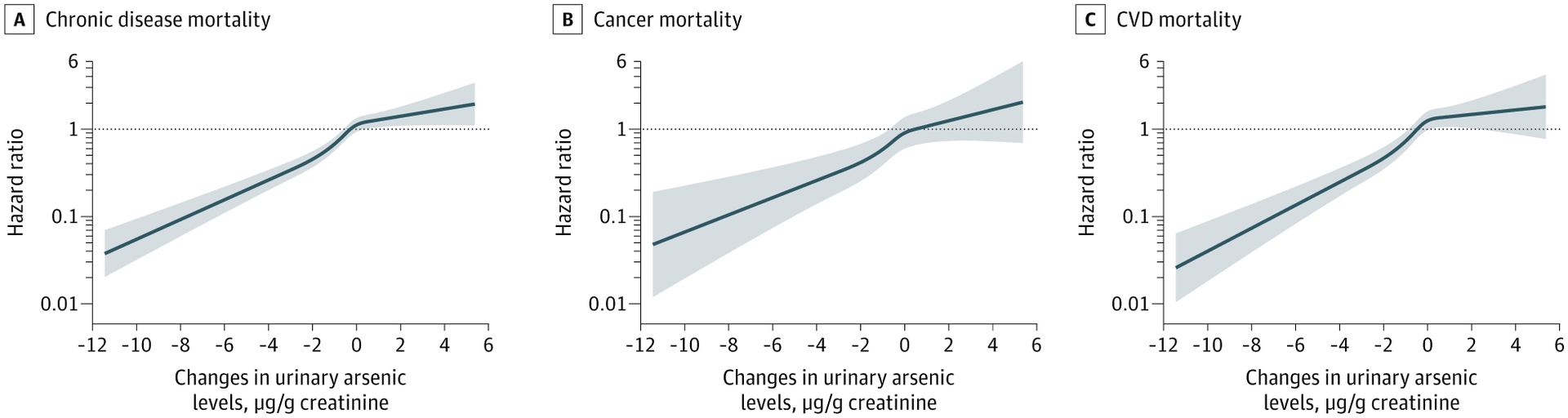
Results Among 10 977 participants (57% female; mean age, 37.0 [SD, 10.1] years), mean urinary arsenic levels declined from 283 (SD, 314) to 132 (SD, 161) µg/g creatinine from 2000 to 2018. Each IQR decrease in urinary arsenic (197 µg/g creatinine) was associated with 22% lower chronic disease mortality (aHR, 0.78 [95% CI, 0.75-0.82]), 20% lower cancer mortality (aHR, 0.80 [95% CI, 0.73-0.87]), and 23% lower CVD mortality (aHR, 0.77 [95% CI, 0.73-0.81]). Time-varying Cox and restricted cubic spline analyses showed larger reductions were associated with lower mortality, while increases were linked to higher risk. Compared with participants with consistently high urinary arsenic levels (above the baseline median of 199 µg/g creatinine [n = 1757]), those whose levels declined below the median (n = 3757) had lower mortality from chronic diseases (aHR, 0.46 [95% CI, 0.39-0.53]), including cancer (aHR, 0.51 [95% CI, 0.35-0.73]) and CVD (aHR, 0.43 [95% CI, 0.34-0.53]), similar to those consistently below the median (n = 4959) (aHR, 0.43-0.49). Findings were similar in propensity score–matched analyses.
Conclusions and Relevance These findings support an association between reduced arsenic exposure and improved health outcomes in populations exposed to contaminated drinking water.