2025-12-18 アリゾナ大学
<関連情報>
- https://news.arizona.edu/news/life-lava-how-microbes-colonize-new-habitats
- https://www.nature.com/articles/s42003-025-09044-1
アイスランドのファグラダルスフィヤル火山の3回の噴火は、微生物群集の急速かつ予測可能な形成を示している Three eruptions at the Fagradalsfjall Volcano in Iceland show rapid and predictable microbial community establishment
Nathan Hadland,Christopher W. Hamilton,Snædís Björnsdóttir & Solange Duhamel
Communications Biology Published:24 November 2025
DOI:https://doi.org/10.1038/s42003-025-09044-1
Abstract
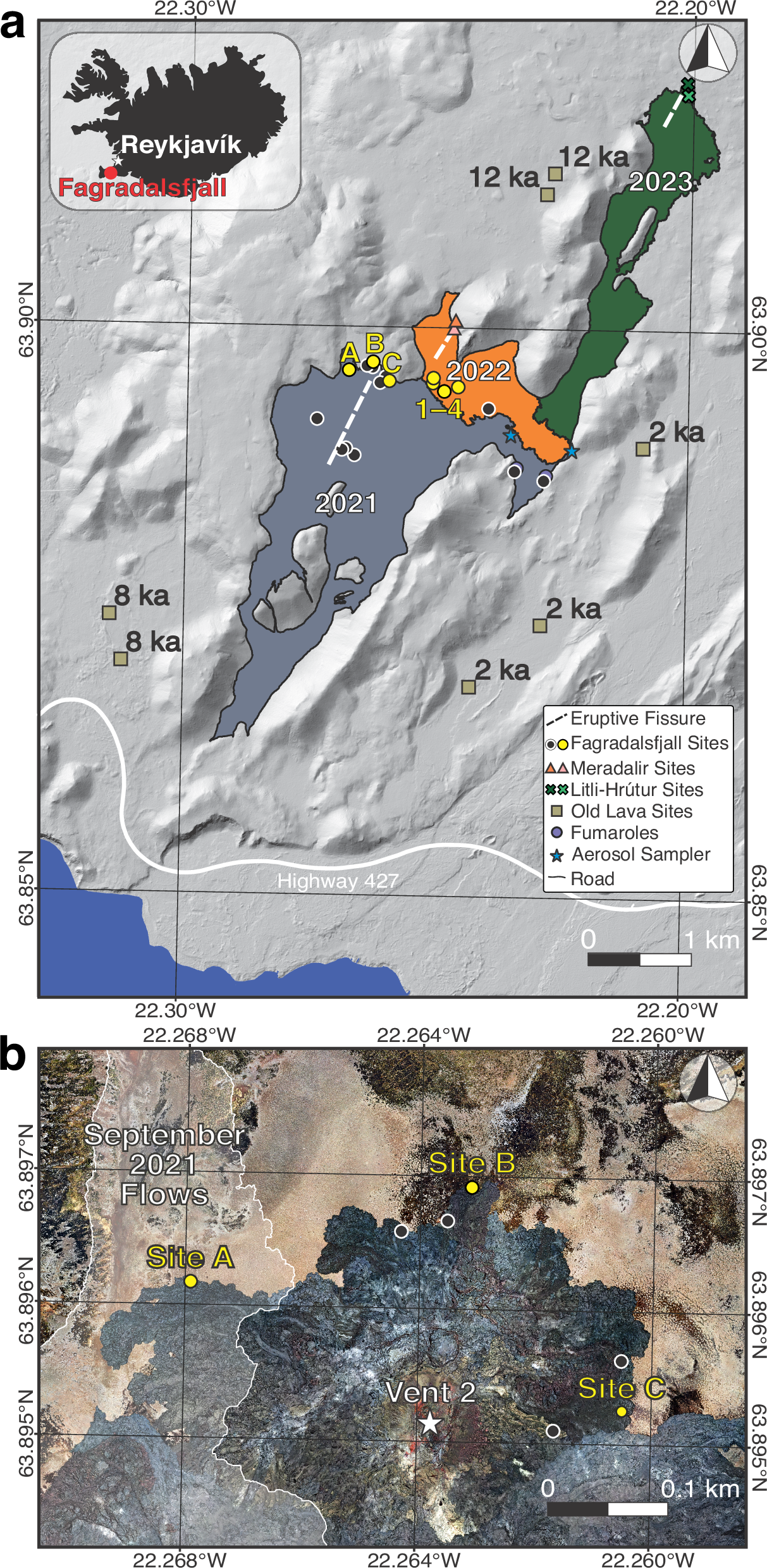
How natural environments transition from uninhabited to inhabited is an incompletely understood question in ecology. We leverage the 2021–2023 Fagradalsfjall eruptions in Iceland as a natural experiment, tracking microbial colonization on the new lava over three years, including lava that had solidified only hours before collection. Samples were collected from fixed sites biweekly for the 2021 eruption phase and then at multiple time points over the next three years, resulting in a unique temporal dataset for primary succession. As the same system erupted again in 2022 and 2023, we were able to monitor a natural ecological triplicate. We use multiple lines of evidence to demonstrate dynamic but predictable community assembly processes. We use alpha and beta diversity, phylogenetic null modeling, taxa volatility, and Bayesian source tracking to propose a two-stage process: (1) rapid establishment of a variable microbial assemblage, followed by (2) stabilization after winter onset. A random forest regression model, trained on 2021 eruption microbial community data, accurately predicts the successional stage in the 2022 and 2023 eruptions. This study underscores the dynamic and predictable nature of microbial colonization in harsh environments, offering insights into primary succession and its role in shaping Earth’s ecosystems.
00331-1/asset/f690467c-5730-42ee-9882-dc47c326329b/main.assets/gr1a.jpg "中年期の特定のうつ症状が20年後の認知症リスク上昇と関連(Specific depressive symptoms in midlife linked to increased dementia risk)")