2026-02-11 ノースウェスタン大学
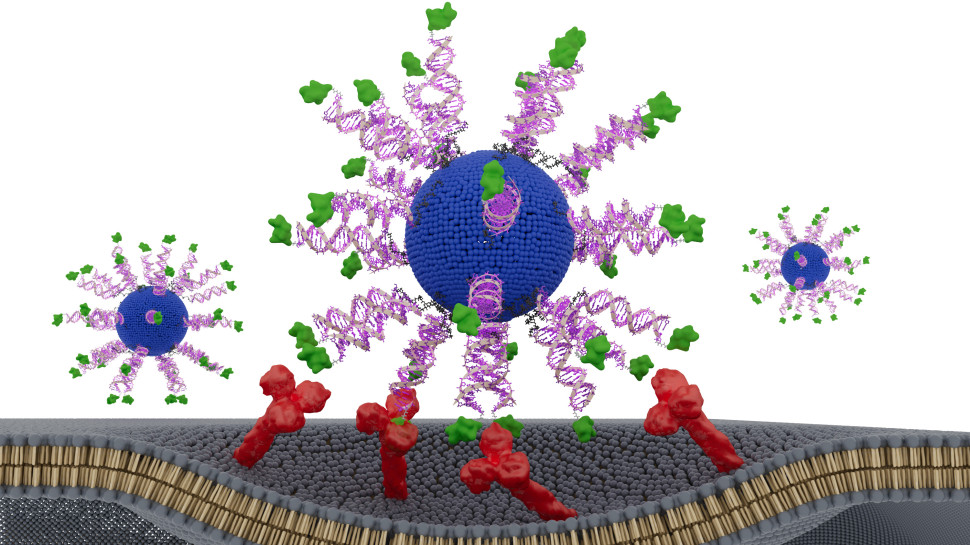
An artistic interpretation of a spherical nucleic acid (SNA) nanoparticle carrying HPV antigen. Image by Connor Forsyth and Jake Cohen from the Mirkin Research Group
<関連情報>
- https://news.northwestern.edu/stories/2026/02/hpv-cancer-vaccine-slows-tumor-growth-extends-survival-in-preclinical-model
- https://www.science.org/doi/10.1126/sciadv.aec3876
E7 11-19の配置と方向は、構造的に定義された球状核酸ワクチンにおけるCD8+ T細胞応答を決定する E711-19 placement and orientation dictate CD8+ T cell response in structurally defined spherical nucleic acid vaccines
Jeongmin Hwang, Tonatiuh A. Ocampo, Vinzenz Mayer, Janice Kang, […] , and Chad A. Mirkin
Science Advances Published:11 Feb 2026
DOI:https://doi.org/10.1126/sciadv.aec3876
Abstract
To develop effective nanostructured immunotherapeutics, identifying structural parameters that maximize immune response is essential. Spherical nucleic acids (SNAs) provide a modular platform for coordinated antigen-adjuvant delivery, where subtle structural differences can markedly influence potency. Herein, three SNAs were designed with HLA-A2–restricted HPV16 E711-19 peptide and CpG adjuvant, nearly identical in composition but differing in antigen presentation. All enhanced dendritic cell activation and CD8+ T cell cytotoxicity in primary human cells compared to peptide-CpG admixture; however, one variant, N-HSNA, elicited the strongest response, inducing ~8-fold higher interferon-γ secretion and ~2.5-fold greater cytotoxicity. In tumor-bearing AAD mice, N-HSNA reduced tumor burden by ~3.5-fold, prolonged survival, and expanded CD8+ T cells. Transcriptomic profiling revealed up-regulation of activation genes and suppression of exhaustion markers. In patient-derived HPV+ head and neck cancer spheroids, N-HSNA enhanced cytotoxicity ~2.5-fold, establishing antigen placement and orientation as key parameters for translational cancer immunotherapy.