2025-06-13 理化学研究所
マウス卵における亜型ヒストンH2A.Zとヒストン修飾H3K4me3の協奏的な役割
<関連情報>
- https://www.riken.jp/press/2025/20250613_3/index.html
- https://www.nature.com/articles/s41594-025-01573-x
H2A.Zは母体のH3K4me3形成を強化し、マウス卵母細胞の減数分裂の進行に必須である H2A.Z reinforces maternal H3K4me3 formation and is essential for meiotic progression in mouse oocytes
Hailiang Mei,Ryoya Hayashi,Chisayo Kozuka,Mami Kumon,Haruhiko Koseki & Azusa Inoue
Nature Structural & Molecular Biology Published:13 June 2025
DOI:https://doi.org/10.1038/s41594-025-01573-x
Abstract
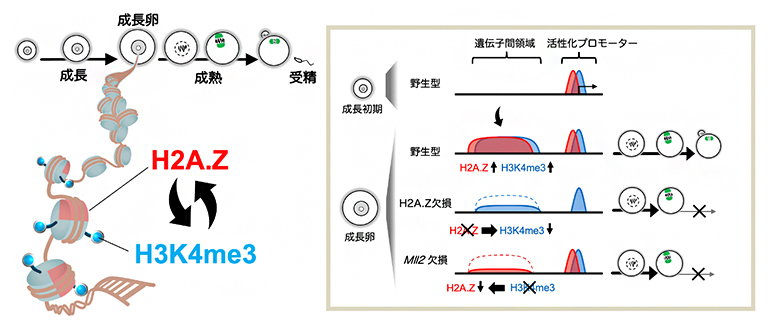
Mammalian oocytes establish a unique landscape of histone modifications, some of which are inherited by early embryos. How histone variants shape the maternal histone landscape remains unknown. Here we map histone H2A variants in mouse fully grown oocytes (FGOs) and find that H2A.Z forms broad domains across intergenic regions, along non-canonical H3K4me3 (ncH3K4me3). During oocyte growth, H2A.Z progressively transitions from an active promoter-rich, canonical distribution to a non-canonical broad distribution (ncH2A.Z). Depletion of H2A.Z in oocytes partially impairs ncH3K4me3 formation and causes severe defects in meiotic progression, which resemble Mll2-knockout oocytes. Conversely, depletion of ncH3K4me3 by Mll2 knockout also causes a reduction of ncH2A.Z in FGOs. Thus, our study suggests that ncH2A.Z and ncH3K4me3 reinforce each other to form functional oocytes.