2025-06-24 中国科学院(CAS)
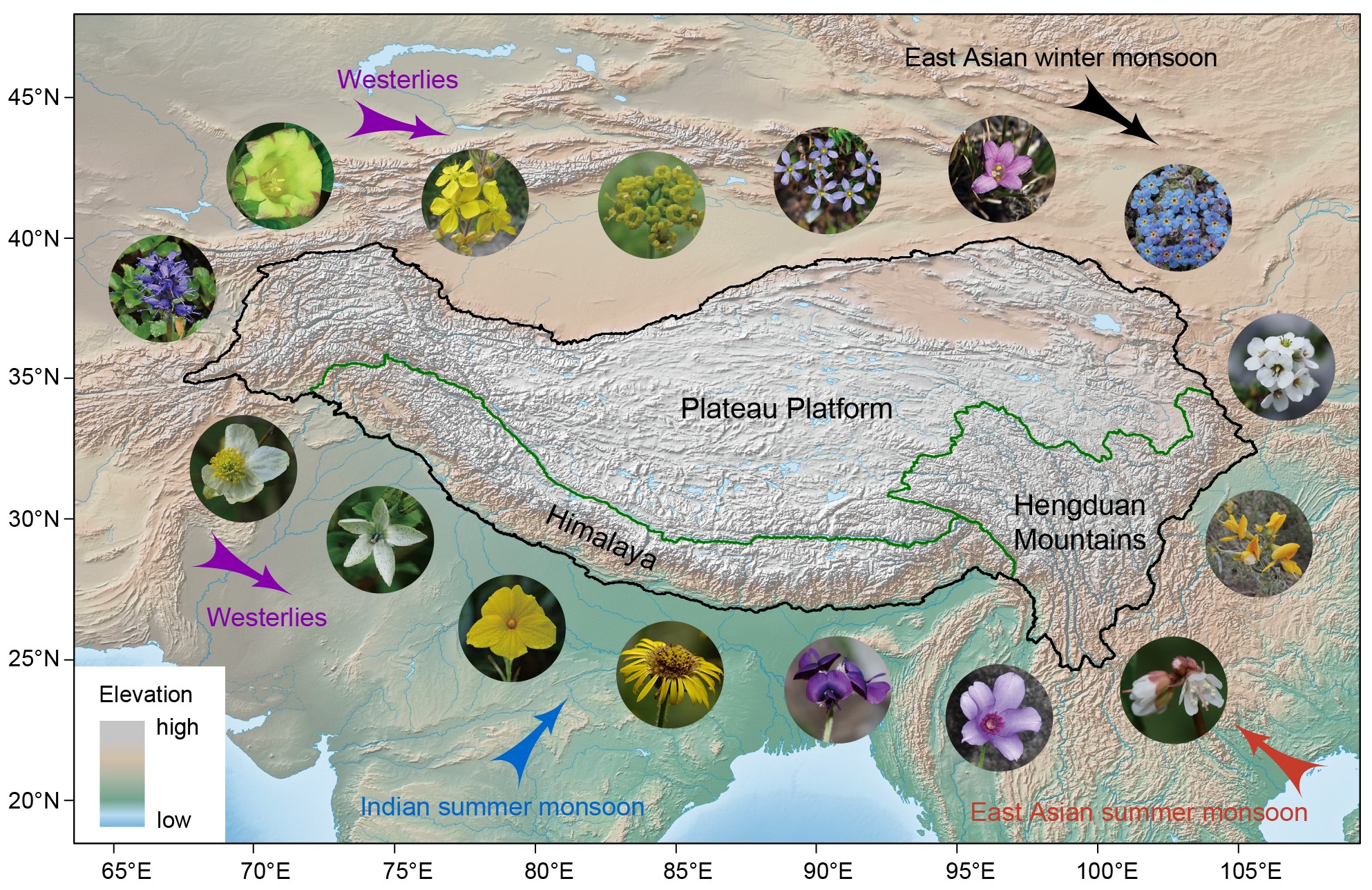
Topographic map of the Qinghai-Tibet Plateau and representative plants (Image by IBCAS)
<関連情報>
- https://english.cas.cn/newsroom/research_news/life/202506/t20250623_1045960.shtml
- https://www.pnas.org/doi/10.1073/pnas.2426017122
新生代の地質気候変動が青海チベット高原の固有植物の進化動態を動かした Cenozoic geoclimatic changes drove the evolutionary dynamics of floristic endemism on the Qinghai–Tibet Plateau
Guan-Long Cao, Xiao-Qian Li, Jun Zhang, +7 , and Wei Wang
Proceedings of the National Academy of Sciences Published:June 23, 2025
DOI:https://doi.org/10.1073/pnas.2426017122
Significance
The Qinghai–Tibet Plateau (QTP) is a hotspot of biodiversity and endemism. Our multitaxon analysis shows that the endemic flora of the QTP had emerged by the Early Eocene. Both long-term in situ speciation and immigration have been responsible for the formation of the floristic endemism in the QTP region, but their contributions to the three subregions of the QTP are markedly different. The processes producing the floristic endemism of the three subregions of the QTP appear asynchronous, probably associated with different geoclimatic events. We further show that the Hengduan Mountains hosts the oldest endemic components of the flora and has served as an important “pump” and “sink” of unique biodiversity, highlighting its great conservation value.
Abstract
The Qinghai–Tibet Plateau (QTP) harbors extraordinarily high levels of biodiversity and endemism. The region is warming at a rate twice the global average, yet the evolutionary dynamics of its unique biota are poorly understood. Here, we used the endemic land plant genera of the QTP to investigate how its floristic endemism was shaped over time by Cenozoic geoclimatic changes. We first clarified that the QTP hosts 82 endemic land plant genera; we found that the origins of these endemic genera were most likely driven by ecological niche and elevation differentiation, caused by the uplift of the QTP and associated climate change. By sampling 37 land plant clades that together encompass 1,740 species, covering all 82 endemic genera, we show that QTP floristic endemism had emerged by the Early Eocene. Furthermore, the unique biodiversity of the QTP comprises a mix of indigenous elements and immigrants. Among the three subregions of the QTP (Plateau Platform, Himalaya, and the Hengduan Mountains), the processes associated with floristic endemism are asynchronous, reflecting different geoclimatic events with the Miocene as a particularly critical period. The relative contributions of in situ speciation and immigration to the unique biodiversity of the three subregions are also markedly different; in situ speciation dominated in the Hengduan Mountains, which hosts the oldest endemic components of the flora and has served as an important “pump” and “sink” of unique biodiversity. These findings provide insights into how past geoclimatic events may have shaped floristic endemism on the QTP and also have important conservation implications.