2025-06-25 生命創成探究センター
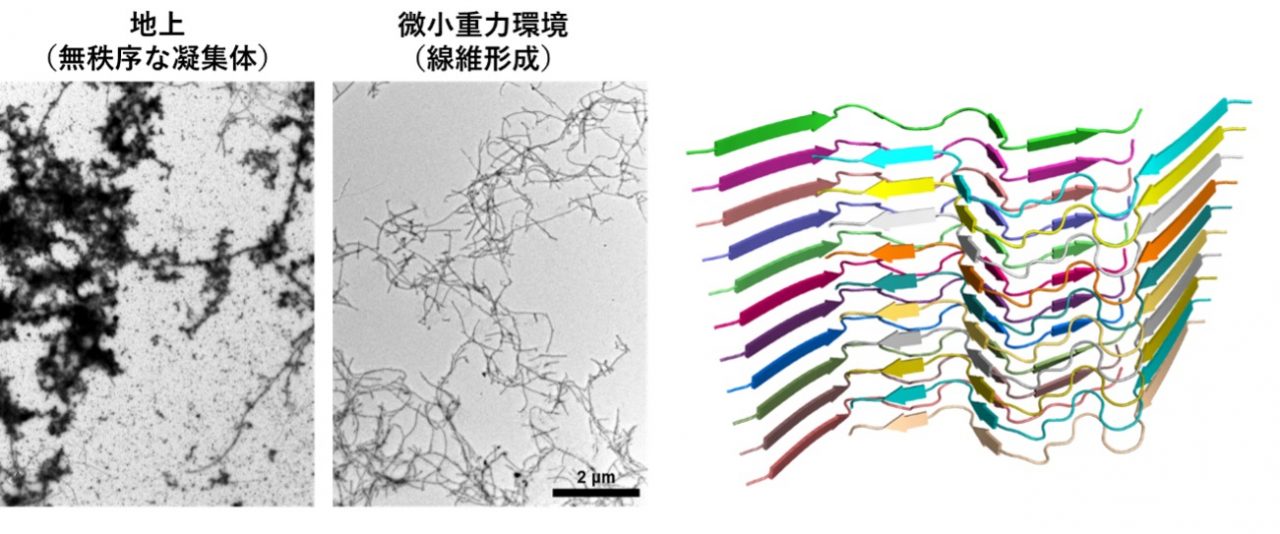
図:(左) Tottori型アミロイドβの集合形態。地上では無秩序な凝集体ができるのに対し、微小重力下では線維形成がみられた。(右)微小重力下で形成したTottori型アミロイド線維の構造(コア構造)。N末端領域は柔軟で秩序立った構造をとっていないことが明らかとなった。
<関連情報>
- https://www.excells.orion.ac.jp/news/12177
- https://www.excells.orion.ac.jp/wp/wp-content/uploads/2025/06/bb49d725f73733ffcadb9a5a59d9a0e6.pdf
- https://pubs.acs.org/doi/10.1021/acschemneuro.5c00217
鳥取型家族性変異D7Nによるアミロイドβのコンフォメーション空間の微小重力下での探索 Microgravity-Assisted Exploration of the Conformational Space of Amyloid β Affected by Tottori-Type Familial Mutation D7N
Maho Yagi-Utsumi,Saeko Yanaka,Raymond N. Burton-Smith,Chihong Song,Christian Ganser,Chiaki Yamazaki,Haruo Kasahara,Toru Shimazu,Takayuki Uchihashi,Kazuyoshi Murata,and Koichi Kato
ACS Chemical Neuroscience Published: June 24, 2025
DOI:https://doi.org/10.1021/acschemneuro.5c00217
Abstract
The amyloid β (Aβ) Tottori variant (D7N) exhibits unique aggregation behaviors and altered fibril formation, posing challenges for structural characterization. To overcome this, the microgravity environment on the International Space Station was employed to study Tottori-type Aβ40 fibril formation and structure. Under Earth gravity, Tottori-type Aβ40 primarily formed nonfibrillar aggregates, hindering detailed structural analysis. In contrast, microgravity significantly enhanced fibril formation and minimized amorphous aggregates. Cryo-electron microscopy revealed two structurally distinct fibril types, each comprising different protomer conformations. In both types, the N-terminal segment was disordered and nor resolved in the density maps. The D7N mutation disrupts the protection of the core by the N-terminal segment often observed in wild-type Aβ40 fibrils, enhancing the hydrophobicity-mediated aggregation propensity. However, microgravity suppressed kinetic traps and facilitated high-quality fibril formation suitable for structural studies that can explore the free energy landscape of Aβ fibril formation. These findings demonstrate the utility of microgravity for studying familial Aβ variants and potentially accelerate our understanding of Aβ aggregation mechanisms in Alzheimer’s disease.