2025-06-27 ハーバード大学
<関連情報>
- https://seas.harvard.edu/news/2025/06/slithering-snakes-science-behind-motion-young-anaconda
- https://www.nature.com/articles/s41567-025-02835-7
滑走するヘビの高速非平面歩行の位相ダイナミクス Topological dynamics of rapid non-planar gaits in slithering snakes
N. Charles,R. Chelakkot,M. Gazzola,B. Young & L. Mahadevan
Nature Physics Published:10 April 2025
DOI:https://doi.org/10.1038/s41567-025-02835-7
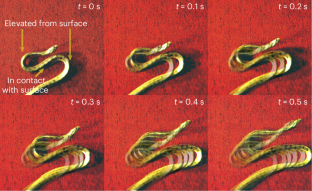
Abstract
Snakes exhibit a wide variety of gaits, including gliding in air and sidewinding on land, which is particularly notable for its out-of-plane motion. Here we report the observation of another non-planar gait used as an escape strategy from threatening situations by juvenile anacondas (Eunectes notaeus), which we refer to as the S-start due to its shape. In this transient mode of locomotion, the snake writhes and bends out of the plane while rolling forward about its midsection without slippage. To quantify our observations, we develop a model for an active non-planar filament that interacts anisotropically with a frictional substrate. We demonstrate that locomotion is due to a propagating localized pulse of a topological quantity—the link density. A two-dimensional phase space characterized by scaled body weight and muscular torque shows that relatively light juveniles are capable of S-starts, whereas heavy adults are not, consistent with our experiments. We also show that a periodic sequence of S-starts naturally leads to a sidewinding gait.