2024-05-13 マックス・プランク研究所
<関連情報>
- https://www.mpg.de/21907281/0508-evan-variability-in-human-body-vocabularies-150495-x
- https://www.nature.com/articles/s41598-024-61140-0
普遍的・文化的要因が身体の部位の語彙を形成する Universal and cultural factors shape body part vocabularies
Annika Tjuka,Robert Forkel & Johann-Mattis List
Scientific Reports Published:07 May 2024
DOI:https://doi.org/10.1038/s41598-024-61140-0
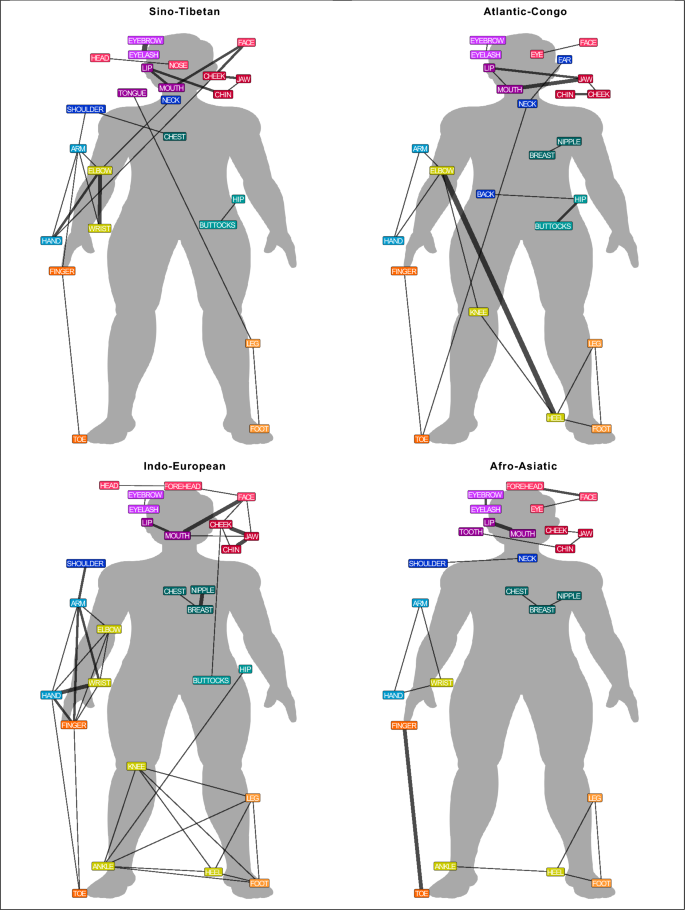
Abstract
Every human has a body. Yet, languages differ in how they divide the body into parts to name them. While universal naming strategies exist, there is also variation in the vocabularies of body parts across languages. In this study, we investigate the similarities and differences in naming two separate body parts with one word, i.e., colexifications. We use a computational approach to create networks of body part vocabularies across languages. The analyses focus on body part networks in large language families, on perceptual features that lead to colexifications of body parts, and on a comparison of network structures in different semantic domains. Our results show that adjacent body parts are colexified frequently. However, preferences for perceptual features such as shape and function lead to variations in body part vocabularies. In addition, body part colexification networks are less varied across language families than networks in the semantic domains of emotion and colour. The study presents the first large-scale comparison of body part vocabularies in 1,028 language varieties and provides important insights into the variability of a universal human domain.