
2025-07-03 カロリンスカ研究所(KI)
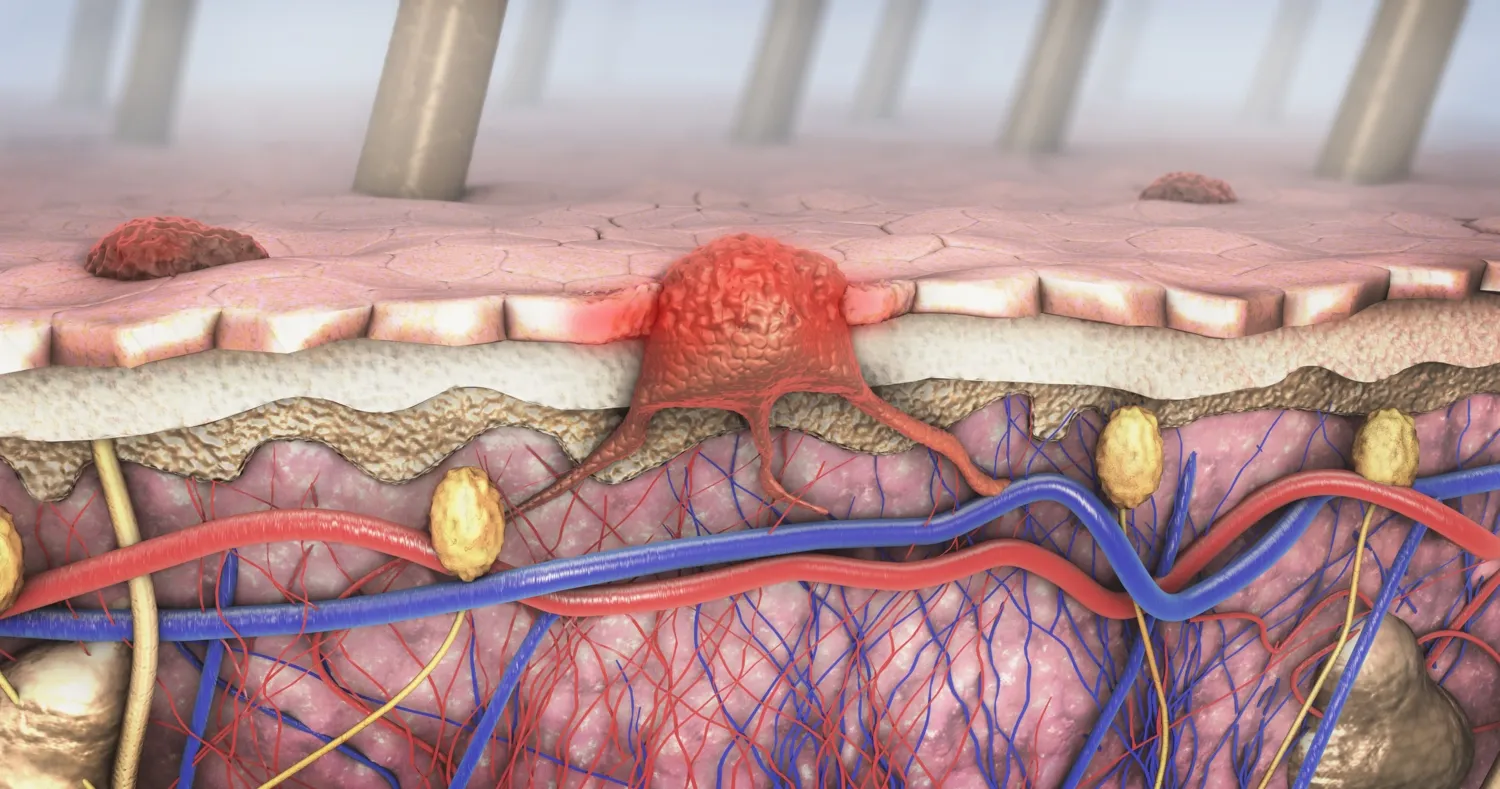 3d illustration of a cross-section of a diseased skin with melanoma that enters the bloodstream and lymphatic tract. Illustration: Getty Images
<関連情報>
- https://news.ki.se/ai-sharpens-pathologists-interpretation-of-tissue-samples
- https://jamanetwork.com/journals/jamanetworkopen/fullarticle/2836021
メラノーマにおける腫瘍浸潤リンパ球の病理医による評価とAIによる評価 Pathologist-Read vs AI-Driven Assessment of Tumor-Infiltrating Lymphocytes in Melanoma
Thazin N. Aung, PhD; Matthew Liu, BSc; David Su, MD; et al
JAMA Network Open Published:July 3, 2025
DOI:10.1001/jamanetworkopen.2025.18906
Key Points
Question Is the use of a machine learning algorithm for tumor-infiltrating lymphocyte (TIL) quantification in melanoma associated with improved reproducibility and prognostic validity compared with traditional pathologist-read methods?
Findings In this prognostic study across 45 institutions with 98 participants, the artificial intelligence (AI) algorithm achieved high reproducibility for all machine learning TIL variables, significantly outperforming traditional pathologist-read methods. AI-based TIL scores also showed prognostic associations with patient outcomes.
Meaning These findings suggest that an AI-driven TIL quantification tool may provide consistent, reliable assessments with a strong potential for clinical integration, offering a robust alternative to traditional methods.
Abstract
Importance Tumor-infiltrating lymphocytes (TILs) are a provocative biomarker in melanoma, influencing diagnosis, prognosis, and immunotherapy outcomes; however, traditional pathologist-read TIL assessment on hematoxylin and eosin–stained slides is prone to interobserver variability, leading to inconsistent clinical decisions. Therefore, development of newer TIL scoring approaches that produce more reliable and consistent readouts is important.
Objective To evaluate the analytical and clinical validity of a machine learning algorithm for TIL quantification in melanoma compared with traditional pathologist-read methods.
Design, Setting, and Participants This multioperator, global, multi-institutional prognostic study compared TIL scoring reproducibility between traditional pathologist-read methods and an artificial intelligence (AI)-driven approach. The study was conducted using retrospective cohorts of patients with melanoma between January 2022 and June 2023 across 45 institutions, with tissue evaluated by participants from academic, clinical, and research institutions. Participants were selected to ensure diverse expertise and professional backgrounds.
Main Outcomes and Measures Intraclass correlation coefficient (ICC) values were calculated for the manual and AI-assisted arms using log-transformed data. Kendall W values were calculated for Clark scores (brisk = 3, nonbrisk = 2, and sparse = 1). Reliabilities of ICC and W values were classified as moderate (0.40-0.60), good (0.61-0.80), or excellent (>0.80). AI TIL measurements were dichotomized using the 16.6 and median cutoffs. Univariable and multivariable Cox regression analyses assessed the prognostic value of TIL scores adjusted for clinicopathologic variables.
Results There were 111 patients with melanoma in the independent testing cohort (median [range] age at diagnosis, 61.0 [25.0-87.0] years; 56 [50.5%] male) who contributed melanoma whole tissue sections. A total of 98 participants evaluated TILs on 60 hematoxylin and eosin–stained melanoma tissue sections. All 40 participants in the manual arm were pathologists, while the AI-assisted arm included 11 pathologists and 47 nonpathologists (scientists). The AI algorithm demonstrated superior reproducibility, with ICCs higher than 0.90 for all machine learning TIL variables, significantly outperforming manual assessments (ICC, 0.61 for AI-derived stromal TILs vs Kendall W, 0.44 for manual Clark TIL scoring). AI-based TIL scores showed prognostic associations with patient outcomes (n = 111) using the median cutoff approach with a hazard ratio (HR) of 0.45 (95% CI, 0.26-0.80; P = .005), and using the cutoff of 16.6, with an HR of 0.56 (95% CI, 0.32-0.98; P = .04).
Conclusions and Relevance In this prognostic study of TIL quantification in melanoma, the AI algorithm demonstrated superior reproducibility and prognostic associations compared with traditional methods. Although the retrospective nature of the cohorts limits demonstration of clinical utility, the publicly available dataset and open-source AI tool offer a foundation for future validation and integration into melanoma management.

