2025-07-10 京都大学
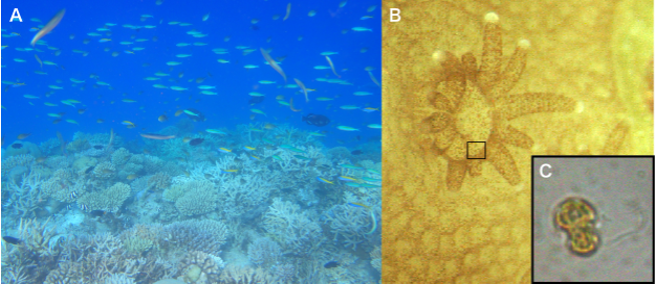
(A)熱帯のサンゴ礁の海 :多様な生物が暮らす。(B)サンゴの顕微鏡観察画像:ポリプという花のような構造が見える。(C)Bの四角内の茶色い点に見える褐虫藻の顕微鏡観察画像。(撮影:石井悠)
<関連情報>
- https://www.kyoto-u.ac.jp/ja/research-news/2025-07-10-1
- https://www.kyoto-u.ac.jp/sites/default/files/2025-07/web_2507_Ishii-a27246bc69bb3c3e354a473f8fc84b02.pdf
- https://academic.oup.com/gbe/advance-article/doi/10.1093/gbe/evaf133/8181046?login=false
サンゴ共⽣性渦鞭⽑藻におけるデンプン合成遺伝⼦の正の選択と、共⽣種および⾃由⽣活種間でのデンプン蓄積の表現型分化 Positive selection of a starch synthesis gene and phenotypic differentiation of starch accumulation in symbiotic and free-living coral symbiont dinoflagellate species
Yuu Ishii , Shunsuke Kanamori , Ryusaku Deguchi , Masakado Kawata , Shinichiro Maruyama , Takashi Yoshida , Ryoma Kamikawa
Genome Biology and Evolution Published:02 July 2025
DOI:https://doi.org/10.1093/gbe/evaf133
Abstract
Symbiosis is a basis for species diversification through interactions between organisms. In tropical and subtropical oceans, dinoflagellate symbionts belonging to the family Symbiodiniaceae, including the genus Symbiodinium, support the flourishment of cnidarian hosts, including corals, and thereby the ecology of oligotrophic oceans through their photosynthate carbon transfers. Although the genus Symbiodinium includes both free-living and symbiotic species, the detailed genetic background of their lifestyle differences remains unclear. In this study, we identified candidate genes involved in the evolutionary acquisition or maintenance of symbiosis in Symbiodinium spp. by detecting genes that have undergone positive selection during symbiotic and free-living lifestyle diversification. Using multiple Symbiodinium genomes to detect positive selection, 35 genes were identified, including a gene encoding soluble starch synthase SSY1 and genes related to metabolite secretion, which may be preferred for symbiotic lifestyles. In particular, our in silico analyses revealed that the SSY1 gene family has undergone extensive gene duplications in an ancestral dinoflagellate, and that the mutations detected as positive selection have occurred in the intrinsically disordered region of one of the homologs. Consistent with molecular evolution, the phenotypes of intracellular starch synthesis/accumulation were distinct between the symbiotic and free-living species of Symbiodinium when cultured under different pH and nitrogen conditions. These results provide molecular and phenotypic insights into symbiotic Symbiodinium-coral relationships.