2025-07-16 アメリカ国立衛生研究所(NIH)
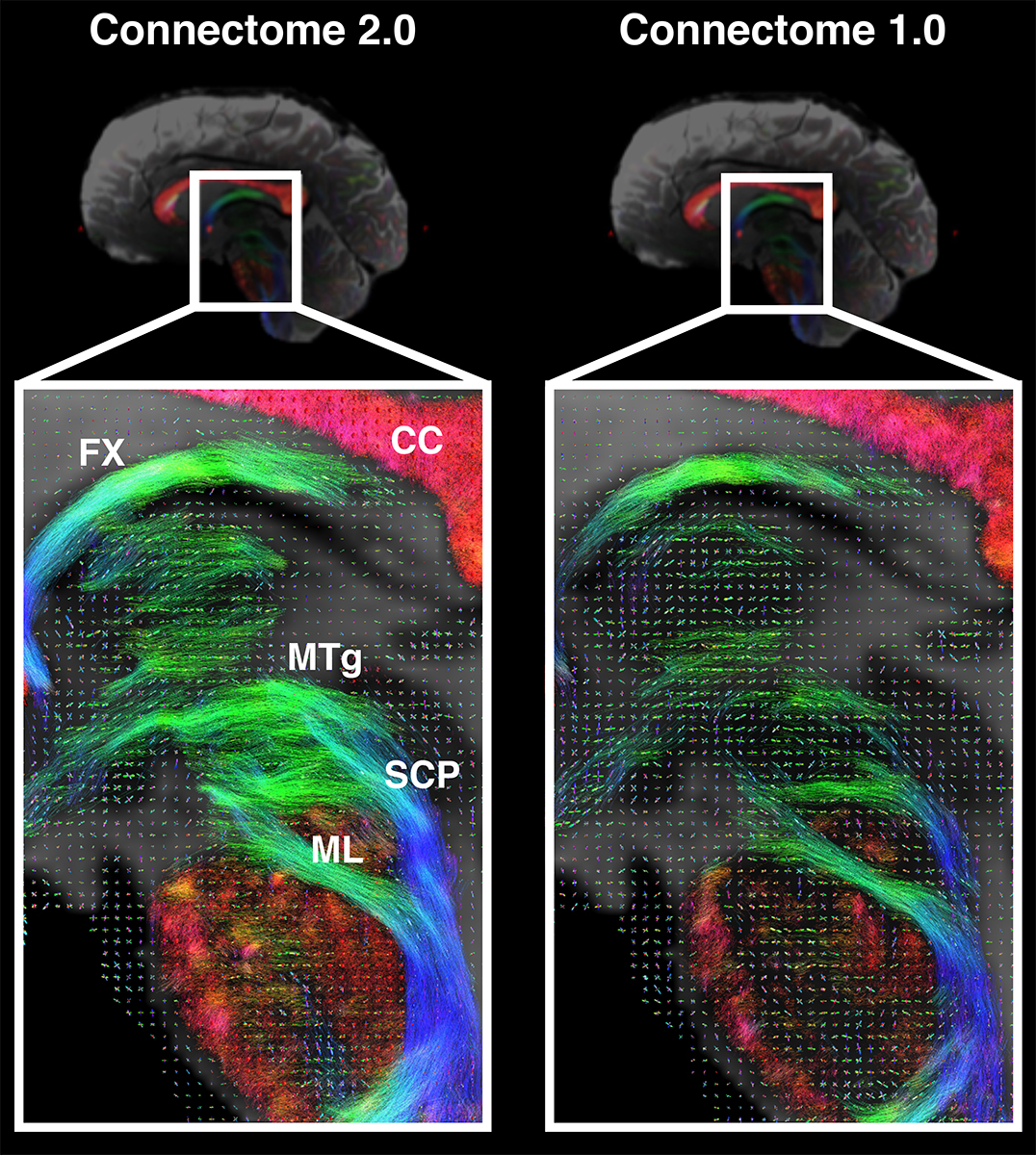
Closeups of the midline sagittal view for Connectome 2.0 (left) and Connectome 1.0 (right) protocols, showing diencephalic and brainstem pathways. Tractography results are shown superimposed onto the underlying fibre orientation distribution functions.
Chiara Maffei, Ph.D.
ChatGPT:
<関連情報>
- https://www.nih.gov/news-events/scientists-develop-high-performance-mri-scanner-effort-define-microscopic-brain-structures
- https://www.nature.com/articles/s41551-025-01457-x
ヒトの脳回路をスケール横断的にイメージングする超高勾配コネクトミクス・微細構造MRIスキャナー Ultra-high gradient connectomics and microstructure MRI scanner for imaging of human brain circuits across scales
Gabriel Ramos-Llordén,Hong-Hsi Lee,Mathias Davids,Peter Dietz,Andreas Krug,John E. Kirsch,Mirsad Mahmutovic,Alina Müller,Yixin Ma,Hansol Lee,Chiara Maffei,Anastasia Yendiki,Berkin Bilgic,Daniel J. Park,Qiyuan Tian,Bryan Clifford,Wei-Ching Lo,Stefan Stocker,Jasmine Fischer,Gudrun Ruyters,Manuela Roesler,Andreas Potthast,Thomas Benner,Elmar Rummert,… Susie Y. Huang
Nature Biomedical Engineering Published:16 July 2025
DOI:https://doi.org/10.1038/s41551-025-01457-x
Abstract
Defining the connectome, the complete matrix of structural connections between the nervous system nodes, is a challenge for human systems neuroscience due to the range of scales that must be bridged. Here we report the design of the Connectome 2.0 human magnetic resonance imaging (MRI) scanner to perform connectomics at the mesoscopic and microscopic scales with strong gradients for in vivo human imaging. We construct a 3-layer head-only gradient coil optimized to minimize peripheral nerve stimulation while achieving a gradient strength of 500 mT m-1 and a slew rate of 600 T m-1 s-1, corresponding to a 5-fold greater gradient performance than state-of-the-art research gradient systems, including the original Connectome (Connectome 1.0) scanner. We find that gains in sensitivity of up to two times were achieved by integrating a 72-channel in vivo head coil and a 64-channel ex vivo whole-brain radiofrequency coil with built-in field monitoring for data fidelity. We demonstrate mapping of fine white matter pathways and inferences of cellular and axonal size and morphology approaching the single-micron level, with at least a 30% sensitivity improvement compared with Connectome 1.0.