2025-08-13 ペンシルベニア州立大学(PennState)
<関連情報>
- https://www.psu.edu/news/agricultural-sciences/story/study-offers-new-insight-mixed-virus-interactions-plants
- https://www.mdpi.com/1999-4915/17/6/789
- https://www.mdpi.com/2223-7747/9/4/509
オルトスポウイルスの拮抗作用は植物小RNAプロファイルに反映される Antagonism in Orthotospoviruses Is Reflected in Plant Small RNA Profile
Md Tariqul Islam,Kaixi Zhao,Nathan Johnson,Michael Axtell and Cristina Rosa
Viruses Published: 30 May 2025
DOI:https://doi.org/10.3390/v17060789
Abstract
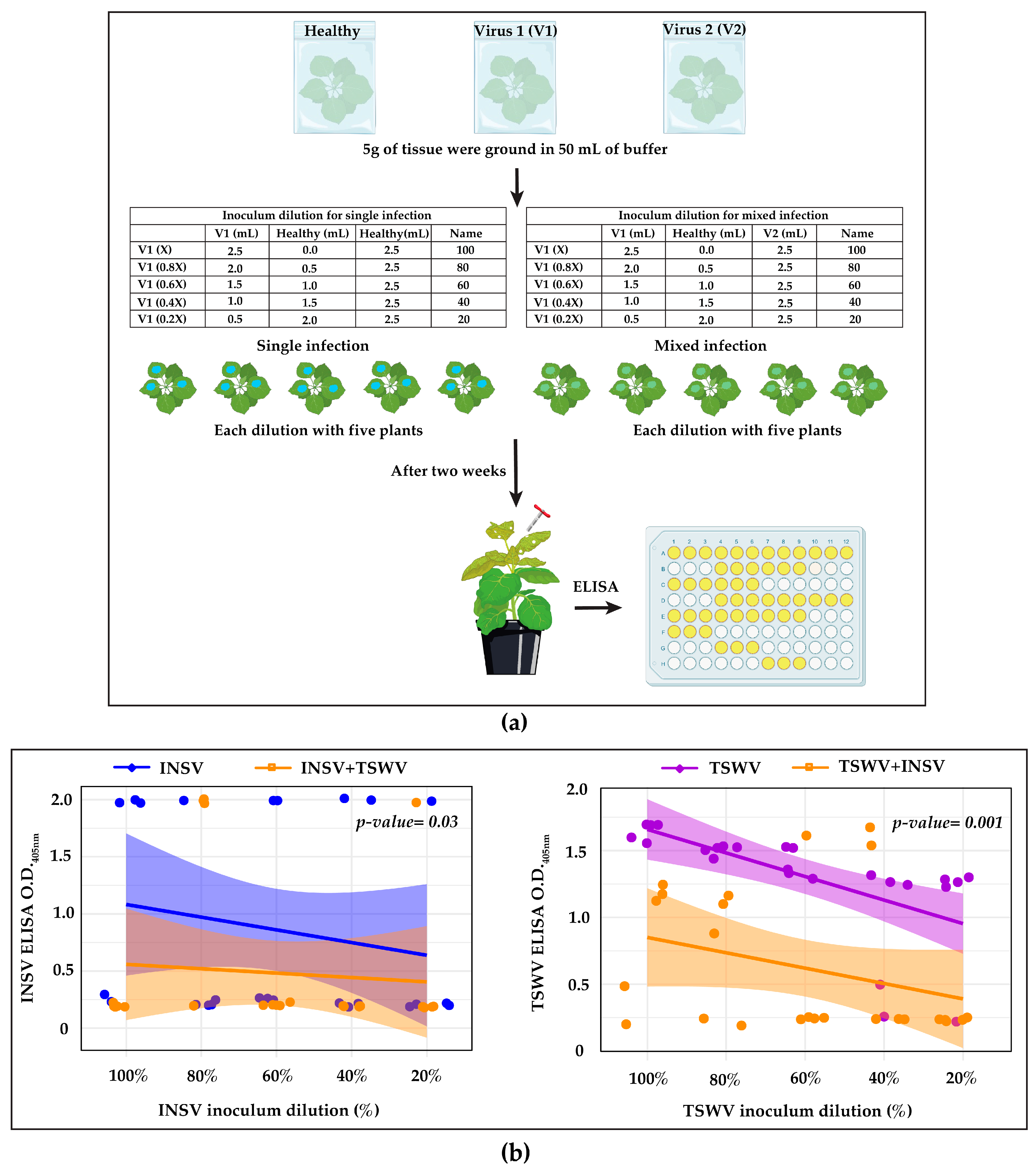
Mixed infections of plant viruses are commonly found in natural patho-systems and present a valuable opportunity to understand how multiple viruses can co-infect the same host. Tomato spotted wilt orthotospovirus (TSWV) and impatiens necrotic spot orthotospovirus (INSV) are present in the same geographic areas and are closely related. More mixed infections of TSWV and INSV have been reported in recent years, and the INSV host range has been reported to be increasing. In a previous study, we isolated and characterized one strain of INSV and one of TSWV and found that they have an antagonistic relationship in their vectors. However, we were unable to determine whether this antagonism extends to the host plant or to uncover the underlying mechanisms and the host’s contribution. Here, we show that TSWV and INSV exhibit antagonistic interactions in the host plant, as evidenced by a lower viral titer in mixed infections compared to single infections. Using small RNA sequencing, we identified that the host plant contributes to this antagonism through differential small RNA processing, which appears to regulate viral replication and the success of infection. This research advances our understanding of virus–virus and virus-host interactions and presents opportunities for leveraging these dynamics in integrated pest management strategies.
2種類のオルトスポウイルス の混合感染における伝播のボトルネックとしてのアザミウマ Thrips as the Transmission Bottleneck for Mixed Infection of Two Orthotospoviruses
Kaixi Zhao and Cristina Rosa
Plants Published: 15 April 2020
DOI:https://doi.org/10.3390/plants9040509
Abstract
Mixed infections provide opportunities for viruses to increase genetic diversity by facilitating genomic reassortment or recombination, and they may lead to the emergence of new virus species. Mixed infections of two economically important orthotospoviruses, Tomato spotted wilt orthotospovirus (TSWV) and Impatiens necrotic spot orthotospovirus (INSV), were found in recent years, but no natural reassortants between INSV and TSWV were ever reported. The goal of this study was to establish how vector preferences and the ability to transmit INSV and TSWV influence transmission and establishment of mixed infections. Our results demonstrate that thrips prefer to oviposit on TSWV and INSV mixed-infected plants over singly infected or healthy plants, providing young nymphs with the opportunity to acquire both viruses. Conversely, we observed that thrips served as a bottleneck during transmission and favored transmission of one of the two viruses over the second one, or over transmission of both viruses simultaneously. This constraint was relaxed in plants, when transmission of TSWV and INSV occurred sequentially, demonstrating that plants serve as orthotospovirus permissive hosts, while thrips serve as a bottleneck. Viral fitness, as measured by virus replication, transmission, and competition with other viral strains, is not well studied in mixed infection. Our study looks at the success of transmission during mixed infection of orthotopoviruses, enhancing the understanding of orthotospovirus epidemiology and evolution.