2025-08-15 アメリカ国立衛生研究所(NIH)
<関連情報>
- https://www.nih.gov/news-events/news-releases/nih-scientists-lay-foundation-potential-gene-editing-therapy-late-onset-tay-sachs
- https://www.jci.org/articles/view/183434
CNS標的型ベース編集による主要な遅発性テイ・サックス変異の緩和がマウスで確認される CNS-targeted base editing of the major late-onset Tay-Sachs mutation alleviates disease in mice
Maria L. Allende, Mari Kono, Y. Terry Lee, Samantha M. Olmsted, Vienna Huso, Jenna Y. Bakir, Florencia Pratto, Cuiling Li, Colleen Byrnes, Galina Tuymetova, Hongling Zhu, Cynthia J. Tifft, and Richard L. Proia
The Journal of Clinical Investigation Published: June 17, 2025
DOI:https://doi.org/10.1172/JCI183434
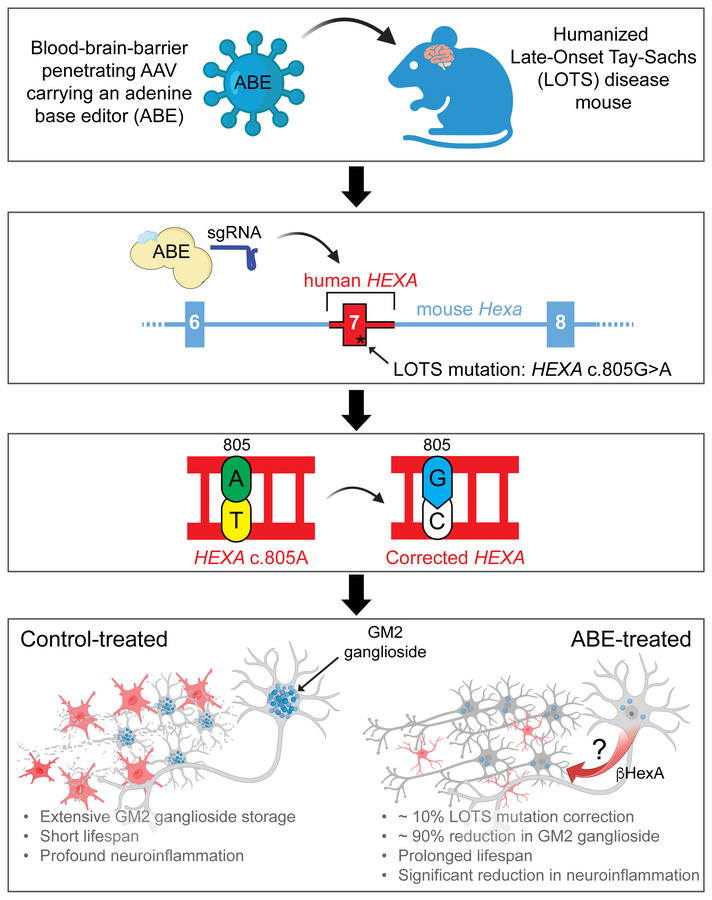
Graphical abstract
Abstract
Late-onset Tay-Sachs (LOTS) disease is a lysosomal storage disorder most commonly caused by a point mutation (c.805G>A) in the HEXA gene encoding the α subunit of the lysosomal enzyme β-hexosaminidase A. LOTS manifests as a range of gradually worsening neurological symptoms beginning in young adulthood. Here, we explored the efficacy of an adenine base editor (ABE) programmed with an sgRNA to correct the HEXA c.805G>A mutation. Base editing in fibroblasts from a patient with LOTS successfully converted the pathogenic HEXA c.805A to G and partially restored β-hexosaminidase activity, with minimal genome-wide off-target editing. We generated a LOTS mouse model in which the mice exhibited decreased β-hexosaminidase activity, accumulation of GM2 ganglioside in the brain, progressive neurological manifestations, and reduced lifespan. Treatment of LOTS mice with the neurotropic virus AAV-PHP.eB carrying the ABE and an sgRNA targeting the LOTS point mutation partially corrected the c.805G>A mutation in the CNS, significantly increased brain β-hexosaminidase activity, and substantially reduced GM2 ganglioside accumulation in the brain. Moreover, the therapy delayed symptom onset and significantly extended median lifespan. These findings highlight the potential of base editing as an effective treatment for LOTS and its broader applicability to other lysosomal storage disorders.