2025-08-21 アメリカ国立衛生研究所 (NIH)
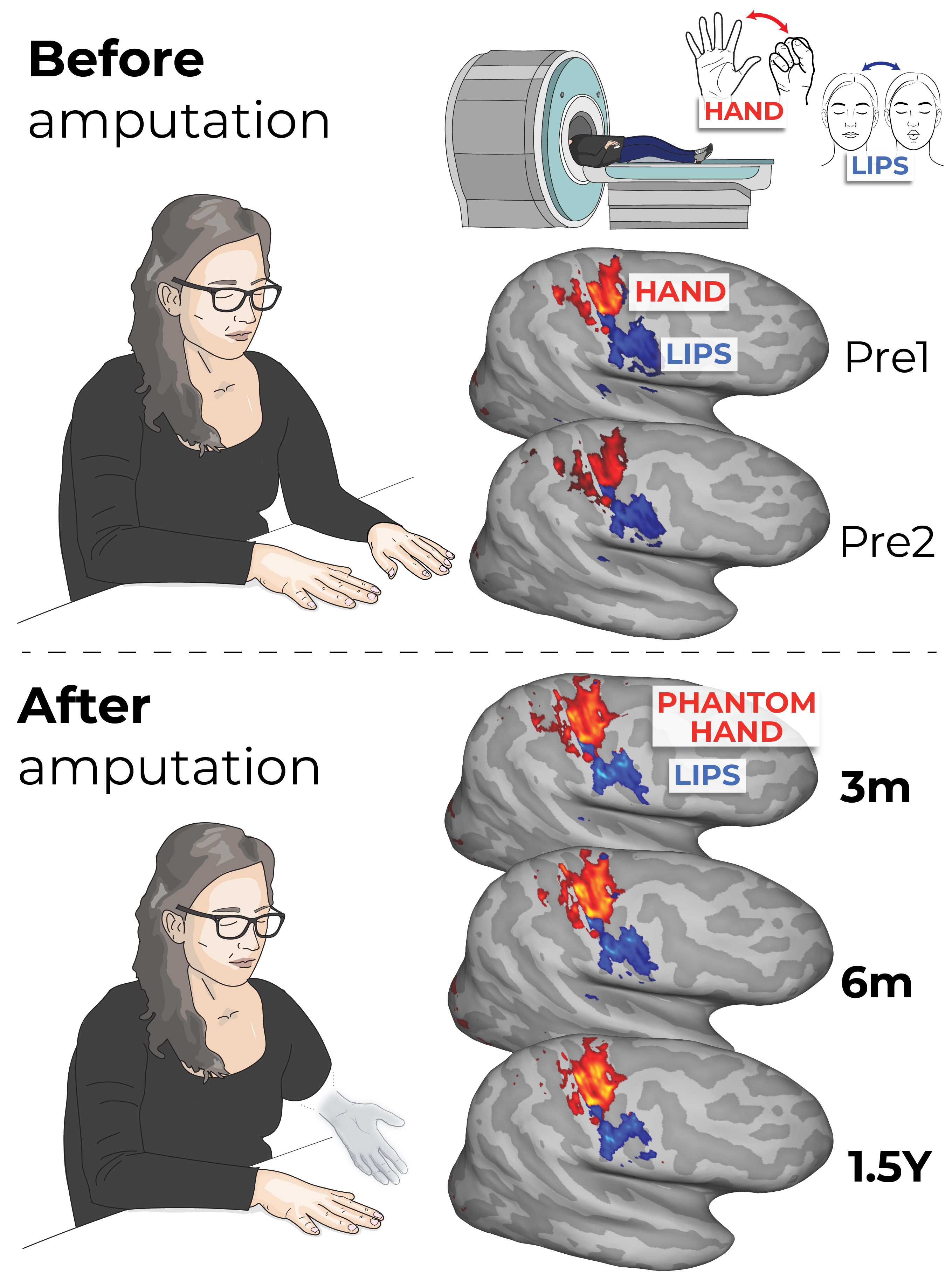 During MRI scans, participants moved their hand (pre-amputation) or phantom hand (post-amputation), as well as their lips (both before and after). Brain maps of the hand (red) and lips (blue) are shown for two pre-amputation scans (pre1, pre2) and multiple post-amputation time points: 3 months, 6 months, and 1.5 years. The maps look the same at each time point demonstrating the stability of the brain’s body map after amputation. Hunter Schone
<関連情報>
- https://www.nih.gov/news-events/news-releases/phantom-limb-study-rewires-our-understanding-brain
- https://www.nature.com/articles/s41593-025-02037-7
腕切断前後における皮質身体地図の安定性 Stable cortical body maps before and after arm amputation
Hunter R. Schone,Roni O. Maimon-Mor,Mathew Kollamkulam,Malgorzata A. Szymanska,Craig Gerrand,Alexander Woollard,Norbert V. Kang,Chris I. Baker & Tamar R. Makin
Nature Neuroscience Published:21 August 2025
DOI:https://doi.org/10.1038/s41593-025-02037-7
Abstract
The adult brain’s capacity for cortical reorganization remains debated. Using longitudinal neuroimaging in three adults, followed before and up to 5 years after arm amputation, we compared cortical activity elicited by movement of the hand (before amputation) versus phantom hand (after amputation) and lips (before and after amputation). We observed stable cortical representations of both hand and lips in primary sensorimotor regions. By directly quantifying activity changes across amputation, we demonstrate that amputation does not trigger large-scale cortical reorganization.