2025-08-06 理化学研究所
本研究成果の概要
<関連情報>
- https://www.riken.jp/press/2025/20250906_1/index.html
- https://www.cell.com/current-biology/fulltext/S0960-9822(25)01040-1
意識的な認識が、2 回目の学習セッションが以前の学習を妨げるか促進するかを決定する Conscious awareness determines whether a second learning session disrupts or facilitates earlier learning
Patrick Bruns ∙ Kazuhisa Shibata ∙ Takeo Watanabe
Current Biology Published:September 5, 2025
DOI:https://doi.org/10.1016/j.cub.2025.08.009
Highlights
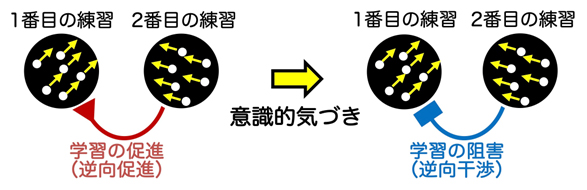
- Successive learning disrupts prior learning, known as retrograde interference
- Subthreshold training reverses this effect, leading to retrograde facilitation
- Facilitation only occurs when training sessions are temporally continuous
- Conscious awareness may transform facilitative interactions into disruptive ones
Summary
Across various types of learning and memory, when a new training session follows a previous one after a certain temporal interval, the previously acquired learning can be disrupted—an effect known as retrograde interference (RI) or catastrophic forgetting.1,2,3,4,5,6,7,8,9,10,11,12,13,14,15 This disruption is thought to result from disrupting interactions between the learning of the first-trained task and the learning of the second-trained task while the former has not yet stabilized.6,7,9,10,16 Such destructive interactions have been considered characteristic not only of RI but also of related phenomena.9,10,11,17,18,19,20,21,22,23,24,25,26,27,28,29 However, we found that when the trained feature was subthreshold, the new learning session unexpectedly improved—rather than impaired—performance on the first-trained task, indicating a retrograde facilitation (RF) effect. We demonstrated this in visual perceptual learning (VPL) by conducting two successive training sessions on different coherent motion directions without any temporal gap. Consistent with previous research, when these directions were suprathreshold (10% coherent motion), the second session disrupted improvements from the first, reflecting RI. By contrast, when the trained directions were subthreshold (5% coherent motion), performance improvement on the first-trained direction was greater with a second session than without—indicating RF. Notably, RF was not observed when a 1-h interval separated the two subthreshold training sessions. This finding suggests that facilitative interactions occur only before the learning of the first-trained direction is stabilized. These results provide a new insight: a stimulus detection system related to conscious awareness transforms what would otherwise be facilitative interactions between successive VPL sessions into disruptive ones.