2025-08-15 バーミンガム大学
<関連情報>
- https://www.birmingham.ac.uk/news/2025/bodys-cells-change-shape-to-deal-with-wounds
- https://www.nature.com/articles/s41556-025-01729-3
エッジ曲率が小胞体の再編成を駆動し、上皮細胞の移動様式を決定する Edge curvature drives endoplasmic reticulum reorganization and dictates epithelial migration mode
Simran Rawal,Pradeep Keshavanarayana,Diya Manoj,Purnati Khuntia,Sanak Banerjee,Basil Thurakkal,Rituraj Marwaha,Fabian Spill & Tamal Das
Nature Cell Biology Published:18 August 2025
DOI:https://doi.org/10.1038/s41556-025-01729-3
Abstract
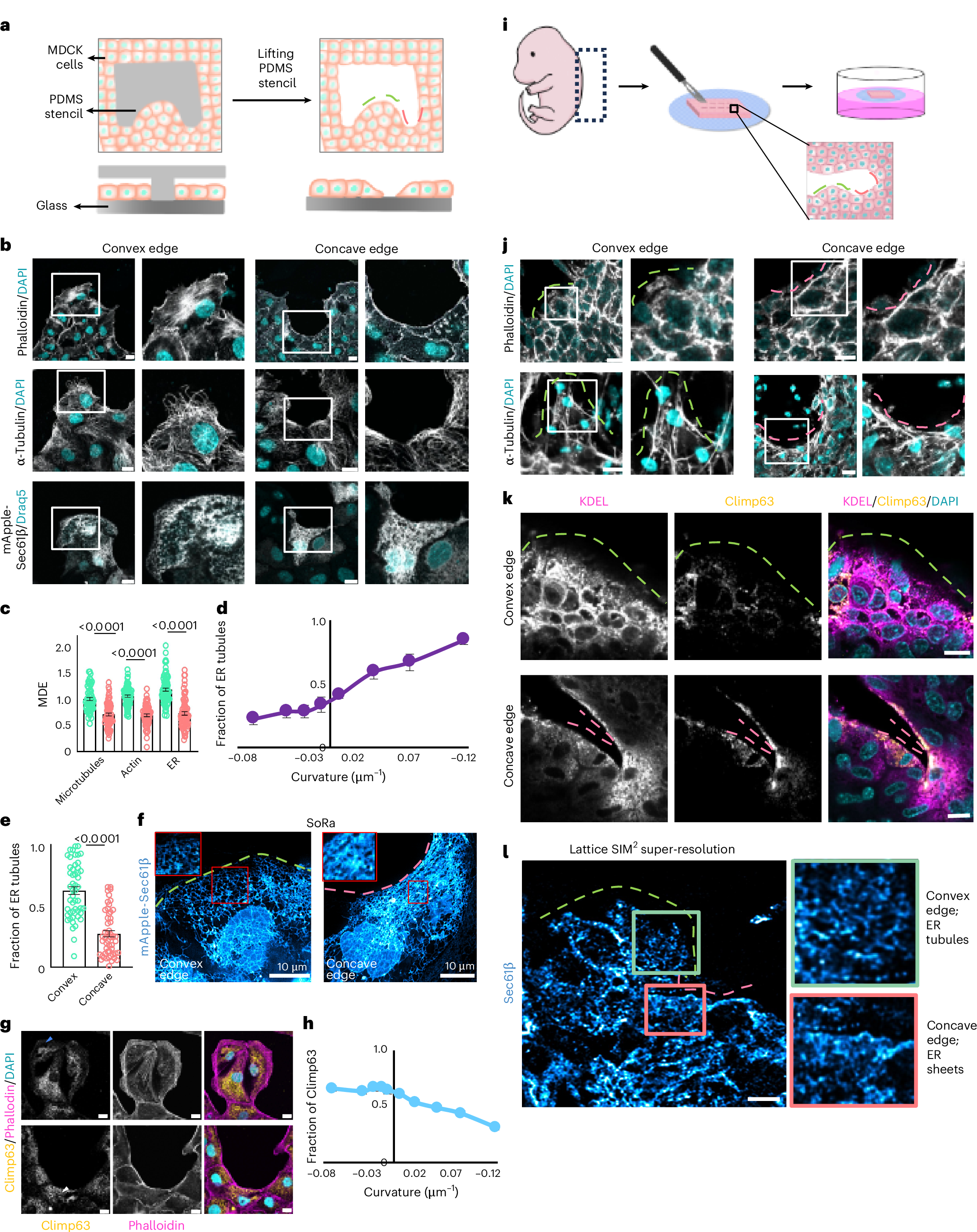
From single-cell extrusion to centimetre-sized wounds, epithelial gaps of various sizes and geometries appear across organisms. Their closure involves two orthogonal modes: lamellipodial crawling at convex edges and purse string-like movements at concave edges. The mechanisms driving this curvature-dependent migration remain unclear. Here we perform an intracellular cartography to reveal that in both micropatterned and naturally arising gaps, the endoplasmic reticulum (ER) undergoes edge curvature-dependent morphological reorganizations, forming tubules at convex edges and sheets at concave edges. This reorganization depends on cytoskeleton-generated protrusive and contractile forces. Mathematical modelling reveals that these morphologies minimize strain energy under their respective geometric regime. Functionally, ER tubules at the convex edge favour perpendicularly oriented focal adhesions, supporting lamellipodial crawling, while ER sheets at the concave edge favour parallelly oriented focal adhesions, supporting purse string-like movements. Altogether, ER emerges as a central mechanotransducer, integrating signals from cytoskeletal networks to orchestrate two orthogonal modes of cell migration.