2025-09-09 イェール大学
<関連情報>
- https://news.yale.edu/2025/09/09/origins-mental-illness-fast-gas-black-hole
- https://www.nature.com/articles/s41467-025-61316-w
- https://www.neurology.org/doi/10.1212/WNL.0000000000213965
ヒト神経幹細胞でモデル化された皮質障害の早期発生起源 Early developmental origins of cortical disorders modeled in human neural stem cells
Xoel Mato-Blanco,Suel-Kee Kim,Alexandre Jourdon,Shaojie Ma,Sang-Hun Choi,Alice M. Giani,Miguel I. Paredes,Andrew T. N. Tebbenkamp,Fuchen Liu,Alvaro Duque,Flora M. Vaccarino,Nenad Sestan,Carlo Colantuoni,Pasko Rakic,Gabriel Santpere & Nicola Micali
Nature Communications Published:09 July 2025
DOI:https://doi.org/10.1038/s41467-025-61316-w
Abstract
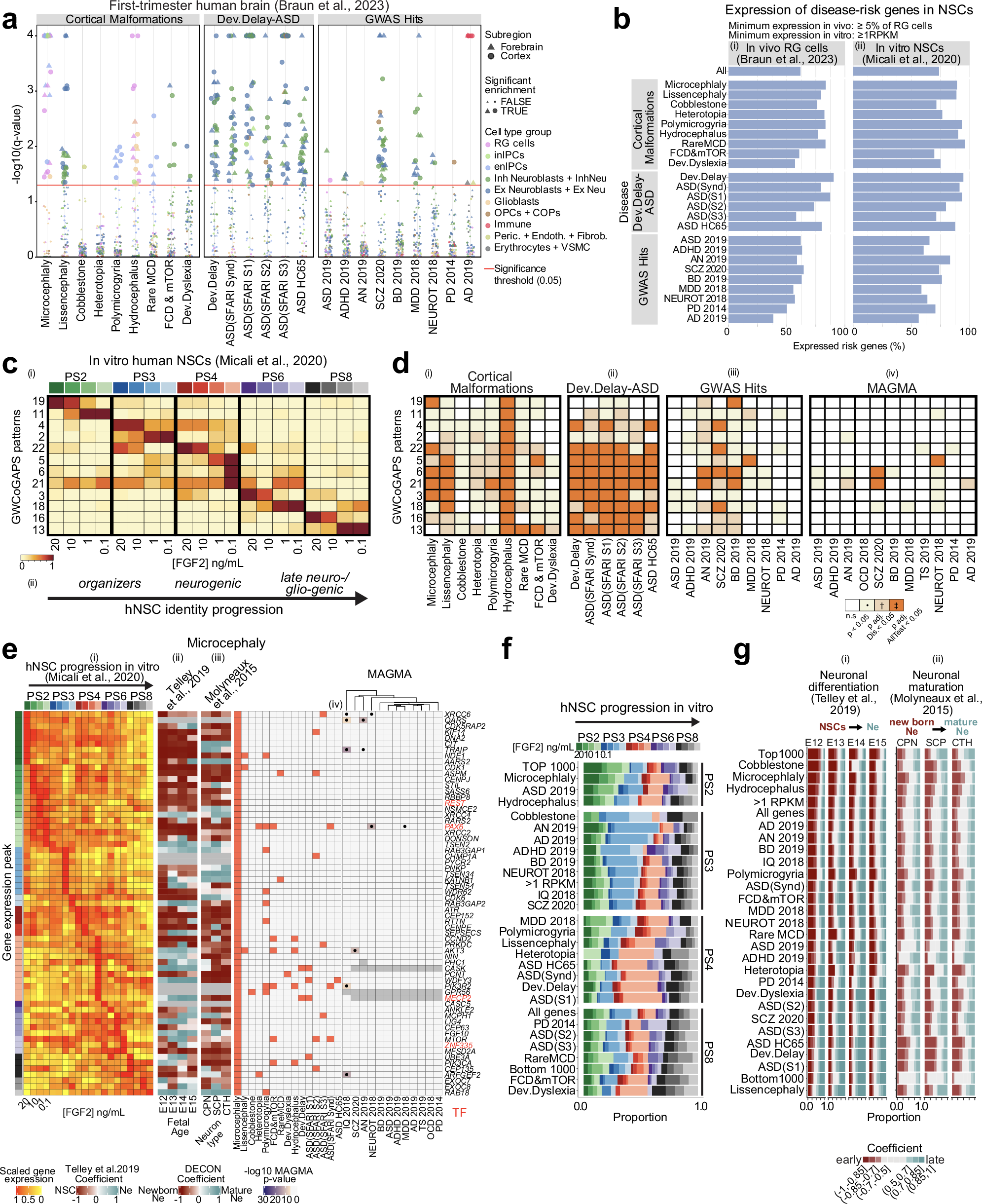
The implications of the early phases of human telencephalic development, involving neural stem cells (NSCs), in the etiology of cortical disorders remain elusive. Here, we explore the expression dynamics of cortical and neuropsychiatric disorder-associated genes in datasets generated from human NSCs across telencephalic fate transitions in vitro and in vivo. We identify risk genes expressed in brain organizers and sequential gene regulatory networks throughout corticogenesis, revealing disease-specific critical phases when NSCs may be more vulnerable to gene dysfunction and converging signaling across multiple diseases. Further, we simulate the impact of risk transcription factor (TF) depletions on neural cell trajectories traversing human corticogenesis and observe a spatiotemporal-dependent effect for each perturbation. Finally, single-cell transcriptomics of autism-affected patient-derived NSCs in vitro reveals recurrent expression alteration of TFs orchestrating brain patterning and NSC lineage commitment. This work opens perspectives to explore human brain dysfunction at early phases of development.
前頭葉発作における脳活動と意識障害の関係性 Relationship Between Brain Activity and Impaired Consciousness in Frontal Lobe Seizures
Elaheh Salardini, Aparna Vaddiparti, Avisha Kumar, Jiayin Qu, Reese Alan Martin, Rahiwa Zefertsion Gebre, Christopher Andrew Arencibia, … , and Hal Blumenfeld
Neurology Published:September 2, 2025
DOI:https://doi.org/10.1212/WNL.0000000000213965
Abstract
Background and Objectives
Impaired consciousness in epilepsy negatively affects quality of life. Previous work has focused on temporal lobe seizures, where cortical slow waves are associated with depressed subcortical arousal and impaired consciousness. However, it is unknown whether frontal lobe seizures also show cortical slow waves or a different activity pattern with impaired consciousness.
Methods
Intracranial EEG (icEEG) recordings from patients at 3 centers were retrospectively assessed to identify seizures originating in the frontal lobe. Seizures were classified as focal preserved consciousness (FPC), focal impaired consciousness (FIC), or focal to bilateral tonic-clonic (FBTC) based on video review. Changes in icEEG power from preictal baseline were calculated in different cortical regions and across frequency ranges in these 3 seizure categories.
Results
Sixty-five seizures in 30 patients (mean age 27.7 years, 43% female) were analyzed. Frontal lobe FPC seizures showed approximately 40% icEEG power increases in the frontal lobe of onset across frequency ranges, with smaller changes in other regions. Frontal lobe FIC seizures showed approximately 50% power increases, not significantly different from FPC seizures in the lobe of onset (p = 0.519, 95% CI -25.8 to 50.4), but with significantly greater power increase in other widespread cortical regions (p < 0.001, 95% CI 14.1–45.3). It is important to note that the widespread icEEG power increases in FIC seizures occurred not just in the slow-wave frequency range, but broadly across other frequencies including fast activity. However, the widespread power increases in FIC seizures differed from those of FBTC seizures where icEEG power increases were much greater at approximately 600%, significantly greater than in FIC seizures in both the frontal lobe of onset and other cortical regions (p < 0.001, 95% CI 330.1–781.9 and 375.3–818.2, respectively).
Discussion
The widespread power increases across frequencies in frontal lobe FIC seizures contrast with those in focal temporal lobe epilepsy, where impaired consciousness is associated with cortical slow waves. These findings suggest that different focal seizure types produce impaired consciousness by affecting widespread cortical regions but through different physiologic mechanisms. Insights gained by studying the physiology of impaired consciousness may be the first step toward developing novel treatments to prevent this significant negative consequence of epilepsy and improve quality of life.