2025-09-10 東京科学大学
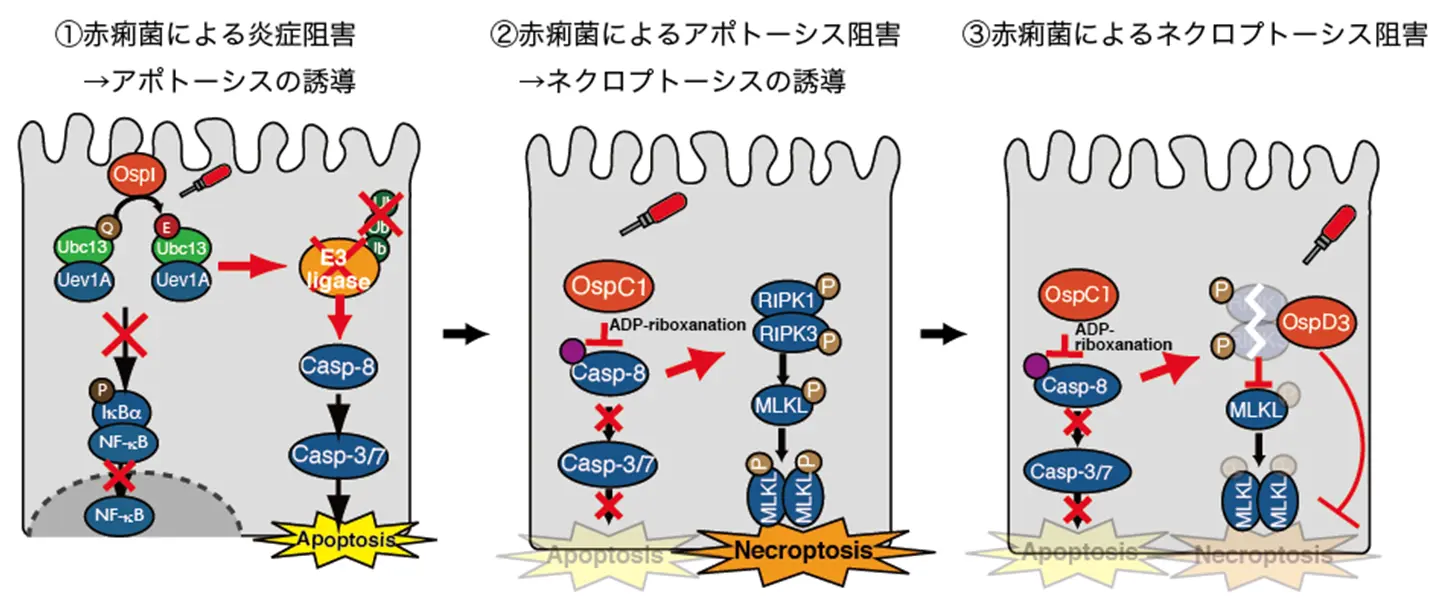
図1. 赤痢菌による細胞死制御メカニズム
<関連情報>
- https://www.isct.ac.jp/ja/news/c90e8vqfz4mx
- https://www.embopress.org/doi/full/10.1038/s44318-025-00561-7
シゲラIII型分泌系エフェクターは宿主炎症と細胞死の誘導を抑制する Shigella type-III secretion system effectors counteract the induction of host inflammation and cell death
Hiroshi Ashida, Tokuju Okano, Tamako Iida, Poramed Onsoi, Chihiro Sasakawa, and Toshihiko Suzuki
The EMBO Journal Published:10 September 2025
DOI:https://doi.org/10.1038/s44318-025-00561-7
Abstract
Many enteric bacterial pathogens deliver virulence effectors to counteract host innate immune responses, such as inflammation and cell death, and colonize the intestinal epithelium. However, host cells recognize the disruption of their innate immune signaling by bacterial effectors and induce alternative immune responses, collectively termed “effector-triggered immunity”, to clear bacterial pathogens. Here, we describe a mechanism of cell death induction via effector-triggered immunity and the bacterial countermeasures of the pathogen Shigella flexneri. Shigella delivers the OspI effector to inhibit NF-κB activation, which results in caspase-8 activation in return. Deamidation and inactivation of the E2 ubiquitin-conjugating enzyme Ubc13 by OspI results in the inactivation of cIAPs, which serves as a cue to trigger apoptosis and necroptosis. To prevent caspase-8-mediated apoptosis, Shigella delivers OspC1 and inhibits caspase-8 activation via its ADP-riboxanation activity, which however triggers necroptosis. Necroptosis induced as a secondary effector-triggered immunity response by OspC1 is eventually prevented by another Shigella effector, OspD3. The findings of this study reveal a complex multilayered bacterial strategy for circumventing host cell death induction via effector-triggered immunity.
Synopsis
Bacterial pathogens produce virulence effectors targeting the innate immune signaling of host cells, which activate alternative, “effector-triggered immunity” mechanisms in response. This study shows how Shigella flexneri uses its type-III secretion system to deliver effectors that counteract the host defense mechanisms.
•Shigella delivers effector OspI to inactivate the E2 ubiquitin-conjugating enzyme Ubc13 of the host cell, thereby preventing NF-κB activation.
•Ubc13 inactivation by OspI triggers caspase-8-initiated apoptosis.
•Shigella delivers ADP-riboxanase effector OspC1 that targets caspase-8, functioning against the initiation of apoptosis.
•Blockade of caspase-8-mediated apoptosis by OspC1 serves as a cue for the induction of necroptosis, which is restricted by another Shigella effector, OspD3.