2025-09-24 ジョージア工科大学(Georgia Tech)
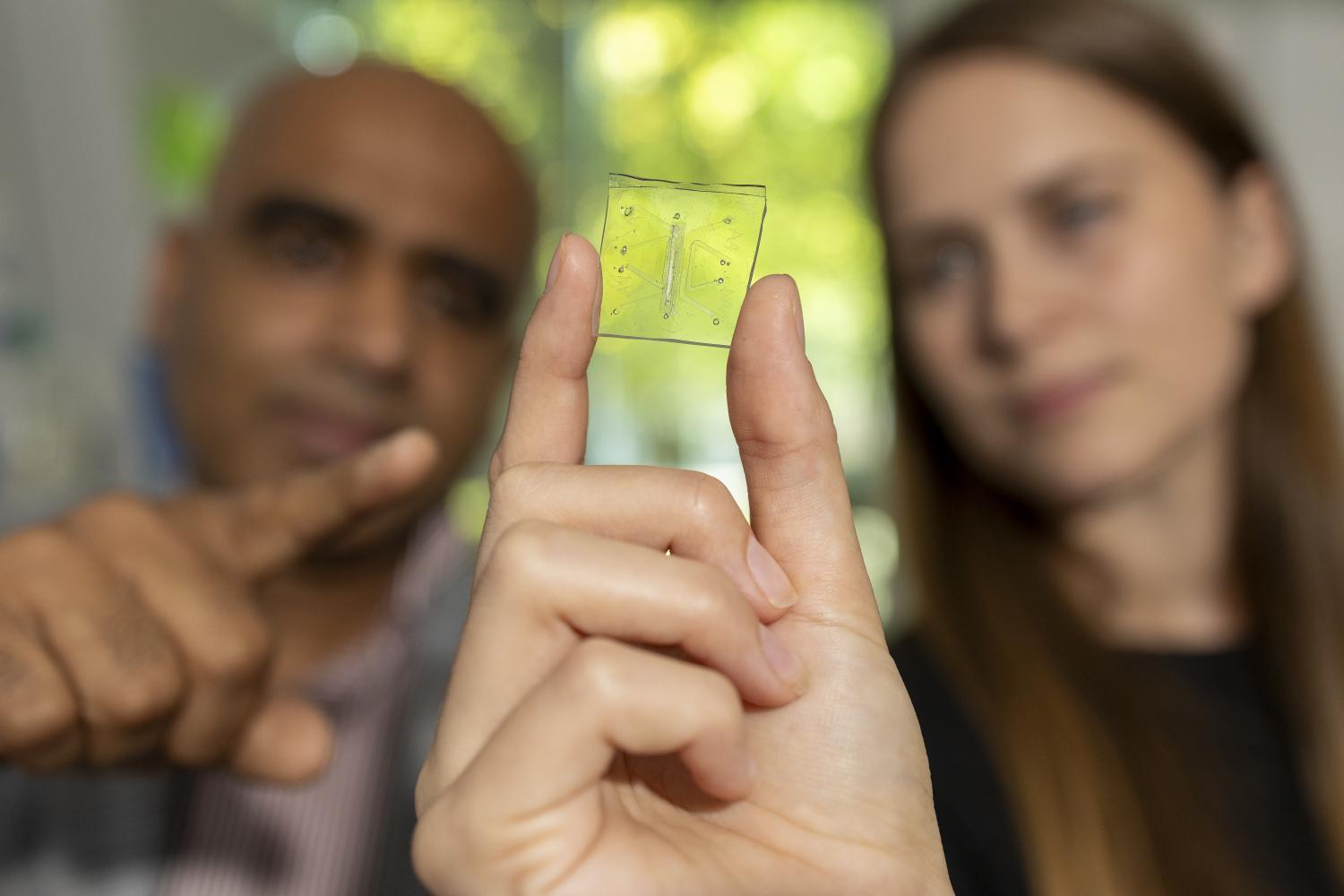
Ankur Singh and Rachel Ringquist point to the microscopic lung-on-a-chip that has a built-in immune system.
<関連情報>
- https://research.gatech.edu/breathtaking-breakthrough-lung-chip-defends-itself
- https://www.nature.com/articles/s41551-025-01491-9
ヒトの重症インフルエンザ感染反応をモデル化するための免疫応答性肺チップ An immune-competent lung-on-a-chip for modelling the human severe influenza infection response
Rachel Ringquist,Eshant Bhatia,Paramita Chatterjee,Drishti Maniar,Zhou Fang,Page Franz,Liana Kramer,Delta Ghoshal,Neha Sonthi,Emma Downey,Joshua Canlas,Abigail Ochal,Savi Agarwal,Valeria Cuéllar,Grace Harrigan,Ahmet F. Coskun,Ankur Singh & Krishnendu Roy
Nature Biomedical Engineering Published:23 September 2025
DOI:https://doi.org/10.1038/s41551-025-01491-9
Abstract
Severe influenza affects 3–5 million people worldwide each year, resulting in more than 300,000 deaths annually. However, standard-of-care antiviral therapeutics have limited effectiveness in these patients. Current preclinical models of severe influenza fail to accurately recapitulate the human immune response to severe viral infection. Here we develop an immune-competent, microvascularized, human lung-on-a-chip device to model the small airways, successfully demonstrating the cytokine storm, immune cell activation, epithelial cell damage, and other cellular- and tissue-level human immune responses to severe H1N1 infection. We find that interleukin-1β and tumour necrosis factor-α play opposing roles in the initiation and regulation of the cytokine storm associated with severe influenza. Furthermore, we discover the critical stromal–immune CXCL12–CXCR4 interaction and its role in immune response to infection. Our results underscore the importance of stromal cells and immune cells in microphysiological models of severe lung disease, describing a scalable model for severe influenza research. We expect the immune-competent human lung-on-a-chip device to enable critical discoveries in respiratory host–pathogen interactions, therapeutic side effects, vaccine potency evaluation, and crosstalk between systemic and mucosal immunity in human lung.