2025-10-01 埼玉大学
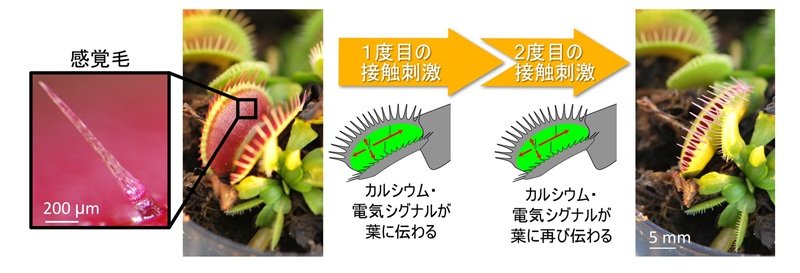
図1.ハエトリソウの接触刺激感知と運動
ハエトリソウの葉では感覚毛で接触刺激を感知すると、葉全体にカルシウムシグナル・電気シグナルが伝わります。葉全体に2度シグナルが伝わると、左右に分かれた葉が閉じ合わさるように運動し獲物を捕らえます。
<関連情報>
- https://www.saitama-u.ac.jp/topics_archives/202509301800.html
- https://www.saitama-u.ac.jp/media/pr202509301800.pdf
- https://www.nature.com/articles/s41467-025-63419-w
MSL10はハエトリグサの触覚を感知する高感度機械センサーである MSL10 is a high-sensitivity mechanosensor in the tactile sense of the Venus flytrap
Hiraku Suda,Hiroki Asakawa,Takuma Hagihara,Shoko Ohi,Shoji Segami,Mitsuyasu Hasebe & Masatsugu Toyota
Nature Communications Published:30 September 2025
DOI:https://doi.org/10.1038/s41467-025-63419-w
Abstract
The tactile sense is essential for living organisms. However, the molecular mechanisms of mechanosensing in plants remain unclear. The Venus flytrap (Dionaea muscipula), a carnivorous plant, possesses mechanosensitive organs called sensory hairs. After sensing a touch stimulus, the hair generates an action potential (AP) and a long-range calcium signal that propagate to the leaf blade, triggering leaf movement to catch prey after two successive calcium signals. Here, we show that the MECHANOSENSITIVE CHANNEL OF SMALL CONDUCTANCE–LIKE homologue (DmMSL10/FLYC1) in the Venus flytrap acts as a high-sensitivity mechanosensor. Using simultaneous intracellular recordings of calcium and electrical signals, we identify a two-step mechanical reception system in the sensory hairs: mechanosensing, limited to the stimulated cell, followed by threshold-dependent AP firing and subsequent calcium signal propagation. In dmmsl10 knockout mutants, long-range calcium and electrical signal propagation are impaired, leading to defective prey detection in planta. Our findings demonstrate that DmMSL10 is crucial for mechanosensing, facilitating AP firing by generating a receptor potential (RP) amplitude.