2025-10-02 マウントサイナイ医療システム(MSHS)
<関連情報>
- https://www.mountsinai.org/about/newsroom/2025/mount-sinai-study-highlights-sex-based-pelvic-differences-effect-on-spinal-screw-rod-placement-during-surgical-procedures
- https://link.springer.com/article/10.1007/s43390-025-01178-w
成人脊椎変形におけるS2-翼状-腸骨骨盤スクリューの位置と腰仙骨ロッドのアライメントに対する性別の影響 Impact of sex on S2-alar-iliac pelvic screw position and lumbosacral rod alignment in adult spine deformity
Ramone M. Brown,Wasil Ahmed,Matthew S. Miyasaka,Daniel Berman,Jeremy Steinberger,Samuel K. Cho,Jun S. Kim & James D. Lin
Spine Deformity Published:22 September 2025
DOI:https://doi.org/10.1007/s43390-025-01178-w
Abstract
Background
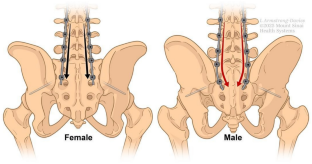
S2 Alar-Iliac (S2AI) screw placement is a common method to achieve stable lumbosacral fixation in the setting of multilevel fusion constructs. Differences in pelvic morphology between males and females can result in a more medial screw starting point in males. This can affect the ability to easily connect the pelvic screw to the rest of the construct. The purpose of this study is to assess the impact of sex and pelvic anatomy on the location of S2AI screw placement and lumbosacral rod alignment in the coronal plane.
Methods
Consecutive cases with S2AI screw placement were identified. Radiographic measurements included the distance between the posterior superior iliac spine (PSIS) on preoperative computed tomography (CT) imaging, distance between S2AI screw heads, and rod-to-rod angles.
Results
Females exhibited significantly greater distance between PSIS compared to males, reflecting sex-based anatomical differences in pelvic structure (p < 0.01). Average rod-to-rod angles were significantly more convergent distally in males than in females (p < 0.05). No significant differences were observed between freehand and stereotactic navigation techniques for rod-to-rod angles or screw distances. PSIS distance was a strong predictor of both rod-to-rod angle (β = 3.3, p < 0.01) and screw distances (β = 0.3, p < 0.01). When evaluating sex and technique as predictors, only sex was significant for PSIS distance (p < 0.01) and rod-to-rod angle (p < 0.05).
Conclusions
The placement of S2AI screws demonstrate sex-based anatomical differences in the location of S2AI screw placement. These anatomical differences should be taken into account in preoperative planning.