2025-10-07 ワシントン大学セントルイス校
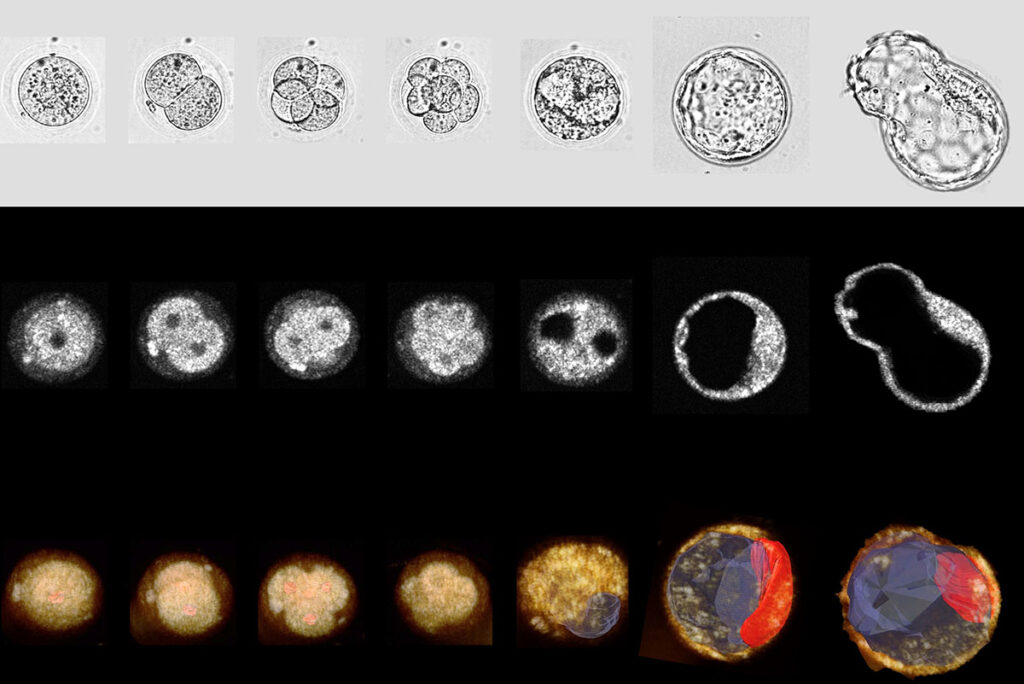
Time-lapse 3D optical coherence microscopy (OCM) and bright-field imaging of a developing mouse embryo during the blastocyst stages. The top row features standard bright-field images, while the second and third rows display the en face slice projection and OCM 3D rendering derived from OCM images, respectively. (Image: Zhou lab)
<関連情報>
- https://source.washu.edu/2025/10/an-inside-look-at-the-earliest-stage-of-life/
- https://engineering.washu.edu/news/2025/An-inside-look-at-the-earliest-stage-of-life.html
- https://www.nature.com/articles/s42003-025-08044-5
タイムラプス明視野顕微鏡と光干渉顕微鏡を用いたマウス胚の品質のラベルフリー評価 Label-free evaluation of mouse embryo quality using time-lapse bright field and optical coherence microscopy
Fei Wang,Senyue Hao,Kibeom Park,Ali Ahmady & Chao Zhou
Communications Biology Published:15 April 2025
DOI:https://doi.org/10.1038/s42003-025-08044-5
Abstract
The selection of high-quality embryos is essential to enhance the implantation rate for in vitro fertilization (IVF). Optical coherence microscopy (OCM) can noninvasively provide three-dimensional (3D) high-resolution imaging of developing embryos. The revealed microstructures can be used for accurate embryo evaluation. Here, we acquire time-lapse 3D OCM images with co-registered bright-field imaging on mouse embryo development from the one-cell stage to the fully hatched blastocyst inside an incubator. Our results demonstrate the capability of OCM to detect structural features of the developing embryos. The second and third embryonic cell cycles are indicated to be associated with blastocyst formation and the hatching capability. OCM-based time-lapse technology holds the potential to enrich early embryo development insights and streamline embryo selection within IVF clinics.