
2025-10-07 ワシントン大学セントルイス校
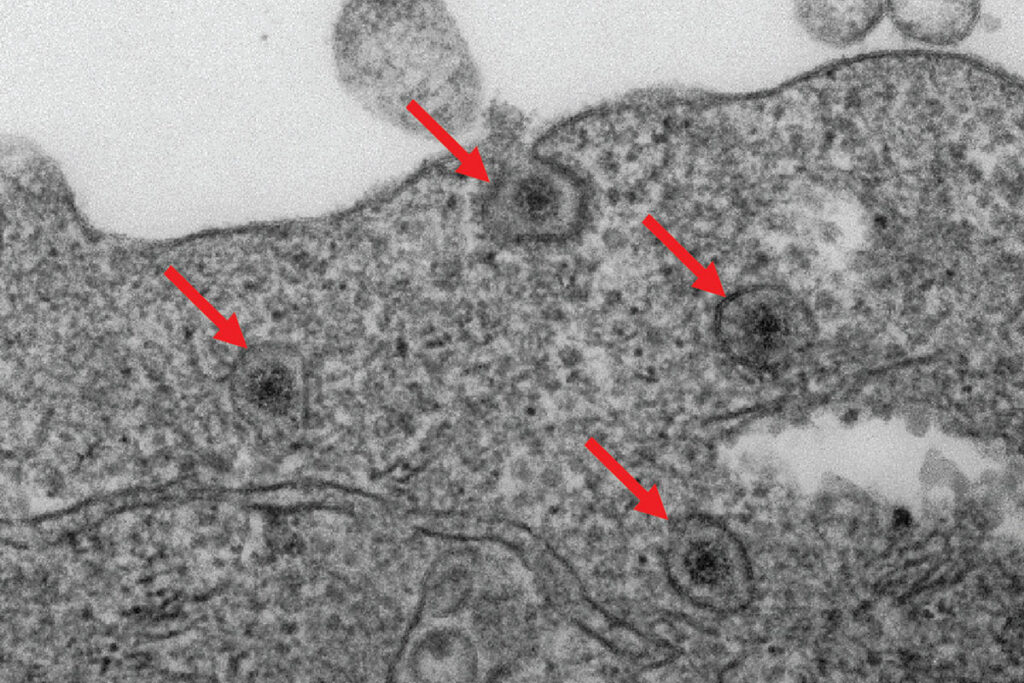
When rotavirus enters a cell without the FA2H enzyme, it becomes trapped in pockets called endosomes (indicated by red arrows). This prevents the virus from infecting the rest of the cell. (Image: Ding Lab/WashU Medicine)
<関連情報>
- https://source.washu.edu/2025/10/researchers-find-key-to-stopping-deadly-infection/
- https://medicine.washu.edu/news/researchers-find-key-to-stopping-deadly-infection/
- https://www.pnas.org/doi/10.1073/pnas.2511911122
脂肪酸2-ヒドロキシラーゼはロタウイルスの脱殻とエンドソームからの脱出を促進する Fatty acid 2-hydroxylase facilitates rotavirus uncoating and endosomal escape
Enkai Li, Ruochen Zang, Takahiro Kawagishi, +8 , and Siyuan Ding
Proceedings of the National Academy of Sciences Published:September 3, 2025
DOI:https://doi.org/10.1073/pnas.2511911122
Significance
Rotaviruses (RVs) are nonenveloped viruses that cause severe diarrhea in children, but how they enter cells is not well understood. This study found that the enzyme fatty acid 2-hydroxylase (FA2H) supports RV entry into host cells. FA2H deletion blocked early steps of viral entry, trapping the virus in endosomes and preventing infection in both human cells and mice. The block could be partially overcome by treatments that alter endosomal calcium levels. Because other pathogenic agents, such as Junín virus and Shiga toxin, also depend on FA2H, these results reveal that 2-hydroxy fatty acids and ceramides may broadly regulate microbial defense, offering insights for the development of host-directed therapies that target fatty acid 2-hydroxylation.
Abstract
Despite the clinical significance of many nonenveloped viruses, the molecular mechanisms of their internalization and membrane penetration are not well understood. Rotaviruses (RVs) are nonenveloped double-stranded RNA viruses and the leading cause of severe dehydrating diarrhea in infants and young children. We identified fatty acid 2-hydroxylase (encoded by FA2H) in the fatty acid 2-hydroxylation pathway as a proviral gene that supports RV infection. Genetic ablation of FA2H interfered with an early step in RV entry for multiple human and animal strains. Intestinal epithelial cell–specific deletion of Fa2h limited RV replication and diarrhea incidence in vivo. Using transmission electron microscopy and immunofluorescence, we found that viral particles were trapped in early and late endosomes in FA2H knockout cells, preventing their further exit into the cytosol. The defect in RV infectivity could be partially restored by treatment of cells with long-chain 2-hydroxy ceramides or a calcium channel activator that promotes Ca2+ efflux from endosomes. Both Junín virus, an arenavirus, and Shiga toxin, dependent on endosomal Ca2+ transport, required FA2H for efficient entry. Together, this study highlights a role of fatty acid 2-hydroxylation in RV entry into host cells and implicates 2-hydroxy ceramides as potential key regulators of endosomal Ca2+ levels, offering important insights for the development of host-directed therapies targeting fatty acid 2-hydroxylation to control microbial infections.

