2025-10-22 東京科学大学
Web要約 の発言:
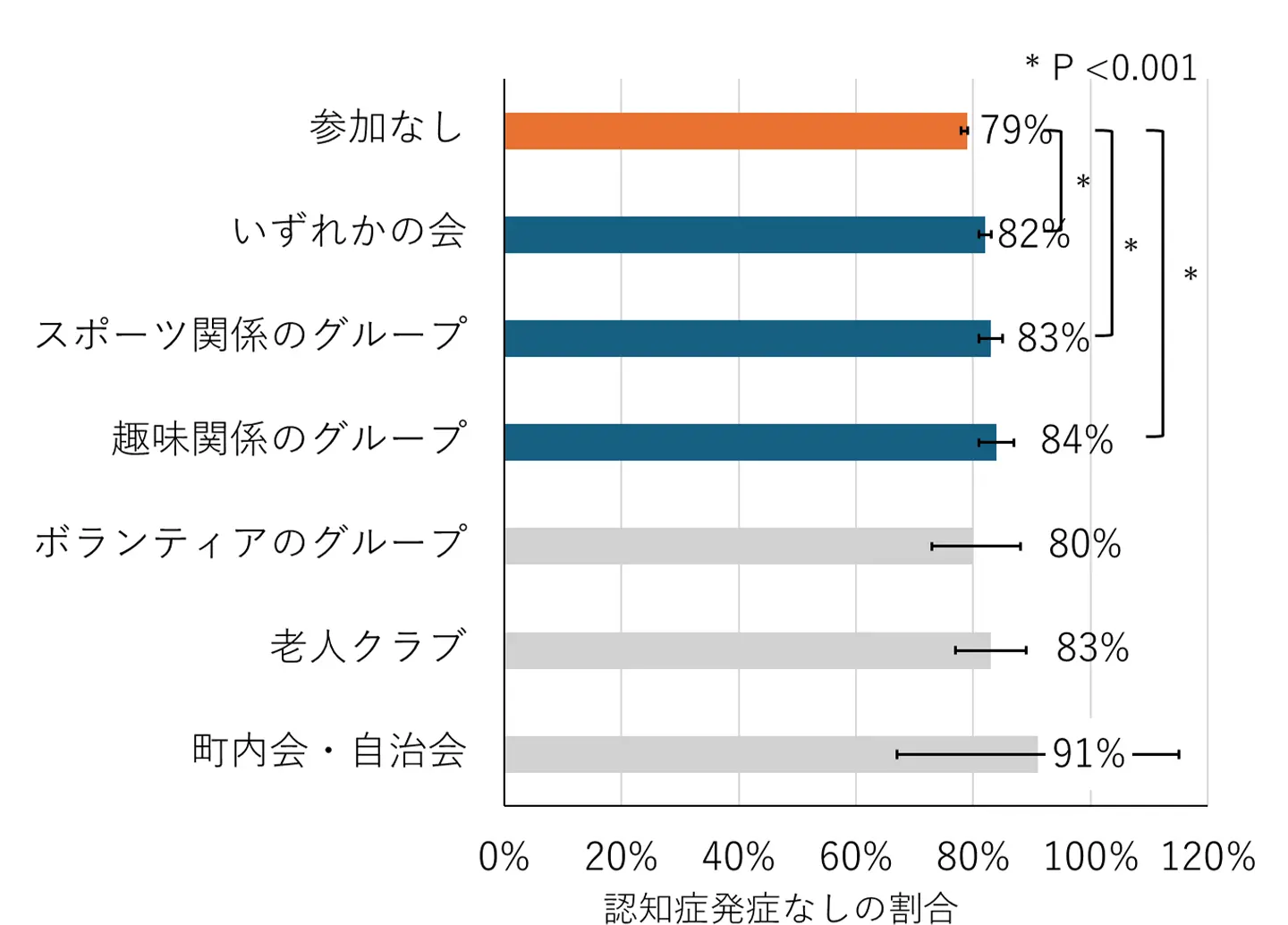
図1. 社会参加の状況と認知症を発症しなかった者の割合(%). 追跡期間中の健康状態などの背景要因を統計的に考慮したうえで、継続的に週1回以上の社会参加をしていた場合、認知症発症なしの割合が高い。
<関連情報>
- https://www.isct.ac.jp/ja/news/aiysyvw4ucol
- https://www.sciencedirect.com/science/article/abs/pii/S0277953625009396
持続的な社会参加と認知症:時間変動曝露分析を用いた日本の縦断的コホート研究からのエビデンス Sustained social participation and dementia: evidence from a Japanese longitudinal cohort study with a time-varying exposure analysis
Yusuke Matsuyama, Kokoro Shirai, Jun Aida
Social Science & Medicine Available online: 22 September 2025
DOI:https://doi.org/10.1016/j.socscimed.2025.118608
Highlights
- We examined the association of sustained social participation with dementia.
- Time-varying, bidirectional nature of social participation and cognition was considered.
- Sustained social participation was linked to a 3.2-point increase in dementia-free survival.
- Sustained social participation reduced dementia risk among older Japanese adults.
Abstract
Social participation is linked to a reduced risk of cognitive impairment and dementia. However, few studies have considered the bidirectional relationship between social participation and cognitive decline over time. We aimed to estimate the effect of sustained social participation on dementia risk reduction among older Japanese adults, accounting for the bias induced by the bidirectional relationship.
A longitudinal study was conducted using data from the Japan Gerontological Evaluation Study. A baseline survey was administered in 2013, with dementia onset information up to 2022 obtained from the municipality registry (n = 47,698; median follow-up 9.2 years). Additional questionnaire surveys in 2016 and 2019 collected data on social participation and time-varying confounders. The average treatment effect (ATE) of sustained social participation on dementia onset was estimated using doubly robust targeted minimum loss-based estimation.
Of the participants, 17.2 % got dementia. Participants with baseline social participation had a lower incidence of dementia (14.7 %) compared to those without social participation (17.8 %). Sustained social participation in any group at least once per week from 2013 to 2019 was associated with a 3.2 percentage point increase in dementia-free survival probability (95 % confidence interval, CI: 1.9, 4.5) compared to never participated. Among specific group types, participation in sports groups (ATE = 4.2; 95 % CI: 2.0, 6.4) and hobby groups (ATE = 5.3; 95 % CI: 2.5, 8.0) was significantly associated with increased dementia-free survival probability.
Sustained social participation was associated with reduced dementia risk among older Japanese adults.