2025-10-18 中国科学院(CAS)
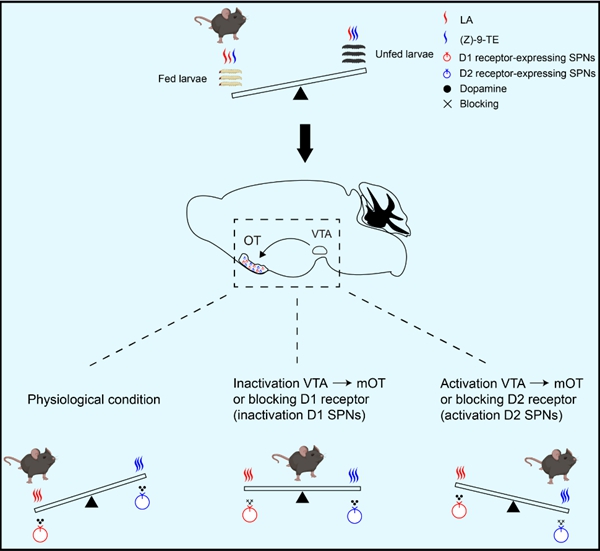
Schematic demonstrating a “seesaw” working model of the VTA-mOT dopaminergic pathway in orchestrating preference for fed over unfed larvae. (Image by Prof. ZHANG Yunfeng’s group)
<関連情報>
- https://english.cas.cn/newsroom/research_news/life/202510/t20251021_1089881.shtml
- https://www.pnas.org/doi/10.1073/pnas.2514847122
中脳から腹側線条体へのドーパミン経路がマウスの匂い誘導昆虫捕食を調整する A midbrain-to-ventral-striatum dopaminergic pathway orchestrates odor-guided insect predation in mice
Wenqiang Wang, Yanbiao Zhong, Ruiyi Tan, +14 , and Yun-Feng Zhang
Proceedings of the National Academy of Sciences Published:October 10, 2025
DOI:https://doi.org/10.1073/pnas.2514847122
Significance
Understanding how predators identify and select nutritious prey is fundamental to deciphering interspecies interactions and energy flow within ecosystems. This study reveals that both laboratory and wild rodents preferentially feed on nutritionally valuable insects based on the odor signatures. We identify functionally distinct neuronal populations in a critical dopaminergic pathway that orchestrate attraction to beneficial food odors and aversion to deterrent ones. These findings provide a fundamental neural framework for odor-guided foraging, bridging sensory perception with motivated feeding behavior. This work advances our understanding of ecological interactions and holds potential for developing strategies in pest management by targeting conserved olfactory evaluation pathways.
Abstract
Foraging and food consumption are fundamental for the survival of animals. In natural environments, wild rodents feed on insects, including moth larvae, and odor-guided evaluation of potential food resources is a critical step in initiating feeding behavior. However, the mechanisms by which rodents seek and feed on insect prey remain poorly understood. Herein, we employed a laboratory-based predator–prey interaction system using mice and cotton bollworm larvae to investigate the neural mechanisms underlying food-seeking and feeding behaviors at both cellular and neural circuit levels. We demonstrate that mice exhibit a strong preference for consuming fed larvae, and this preference is dependent on the main olfactory system. Gas chromatography-mass spectrometry analysis revealed significant differences in the chemical profiles of fed and unfed larvae, with fed larvae containing a higher level of linoleic acid (LA) and a lower level of (Z)-9-tricosene [(Z)-9-TE]. Behavioral assays showed that mice, as well as Brand’s voles and brown rats, are attracted to LA but avoid (Z)-9-TE in a two-choice odor preference test. Furthermore, we identified that the dopaminergic pathway from the ventral tegmental area (VTA) to the medial olfactory tubercle (mOT) plays a central role in mediating this preference. Chemogenetic inhibition of this pathway abolished the preference for LA over (Z)-9-TE, while chemogenetic activation reversed this effect. Additionally, fiber photometry recordings and pharmacology revealed that mOT D1 and D2 spiny projection neurons preferentially mediate attraction to LA and avoidance of (Z)-9-TE, respectively. These findings uncover a neurobiological system in rodents that supports insect predation based upon chemosignals.