2025-10-23 ミュンヘン大学(LMU)
Web要約 の発言:
<関連情報>
- https://www.lmu.de/en/newsroom/news-overview/news/programmable-nanorobots-made-of-dna.html
- https://www.science.org/doi/10.1126/scirobotics.adu3679
モジュール型ナノロボット用のエネルギー供給ハードウェアとしてのバネ式DNA折り紙アレイSpring-loaded DNA origami arrays as energy-supplied hardware for modular nanorobot
Martina Pfeiffer, Fiona Cole, Dongfang Wang, Yonggang Ke, and Philip Tinnefeld
Science Robotics Published:22 Oct 2025
DOI:https://doi.org/10.1126/scirobotics.adu3679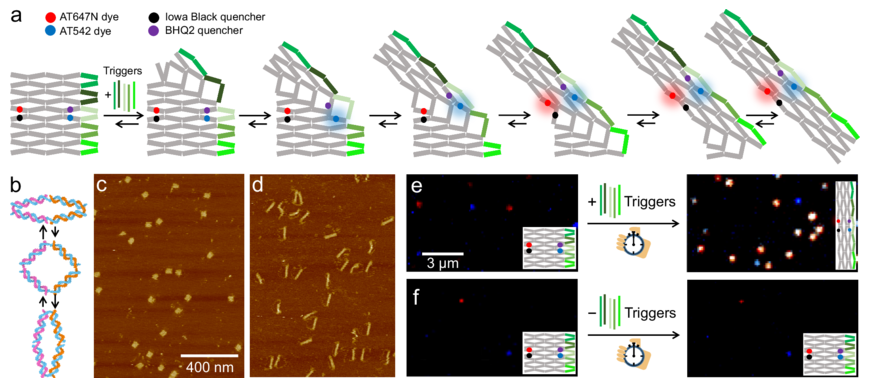
Abstract
DNA origami nanorobots allow for the rational design of nanomachines that respond to environmental stimuli with preprogrammed tasks. To date, this mostly is achieved by constructing two-state switches that, upon activation, change their conformation, resulting in the performance of an operation. Their applicability is often limited to a single, specific stimulus-output combination because of their intrinsic properties as two-state systems only. This makes expanding them further challenging. Here, we addressed this limitation by introducing reconfigurable DNA origami arrays as networks of coupled two-state systems. This universal design strategy enables the integration of various operational units into any two-state system within the nanorobot, allowing it to process multiple stimuli, compute responses using multilevel Boolean logic, and execute a range of operations with controlled order, timing, and spatial position. We anticipate that this strategy will be instrumental in further developing DNA origami nanorobots for applications in various technological fields.