2025-10-22 中国科学院 (CAS)
中国科学院武漢植物園の研究チームは、雲南省シャングリラ近郊の高山草原において、120種以上の昆虫媒介植物と258種の送粉者(主にハチ・ハエ)を対象に調査し、花粉媒介による植物間の間接的相互作用が生態系多様性維持に重要であることを明らかにした。約7,000回の訪花データから、植物間の間接的つながりは直接的な送粉相互作用の6倍多く、ネットワークの入れ子構造(nestedness)を強化して種共存を促すことが判明。ハチ媒介ネットワークでは花冠筒長、ハエでは開花期間が共有送粉者を決定し、豊富な花をもつ種が「ハブ」として周辺植物への送粉を促進していた。解析の結果、種特性よりも種の豊富さ(中立過程)が間接相互作用をよく説明した。この研究は、高山草原の高多様性維持機構と送粉生態系の「見えない支柱」としての役割を示すものである。成果は『Journal of Ecology』に掲載。
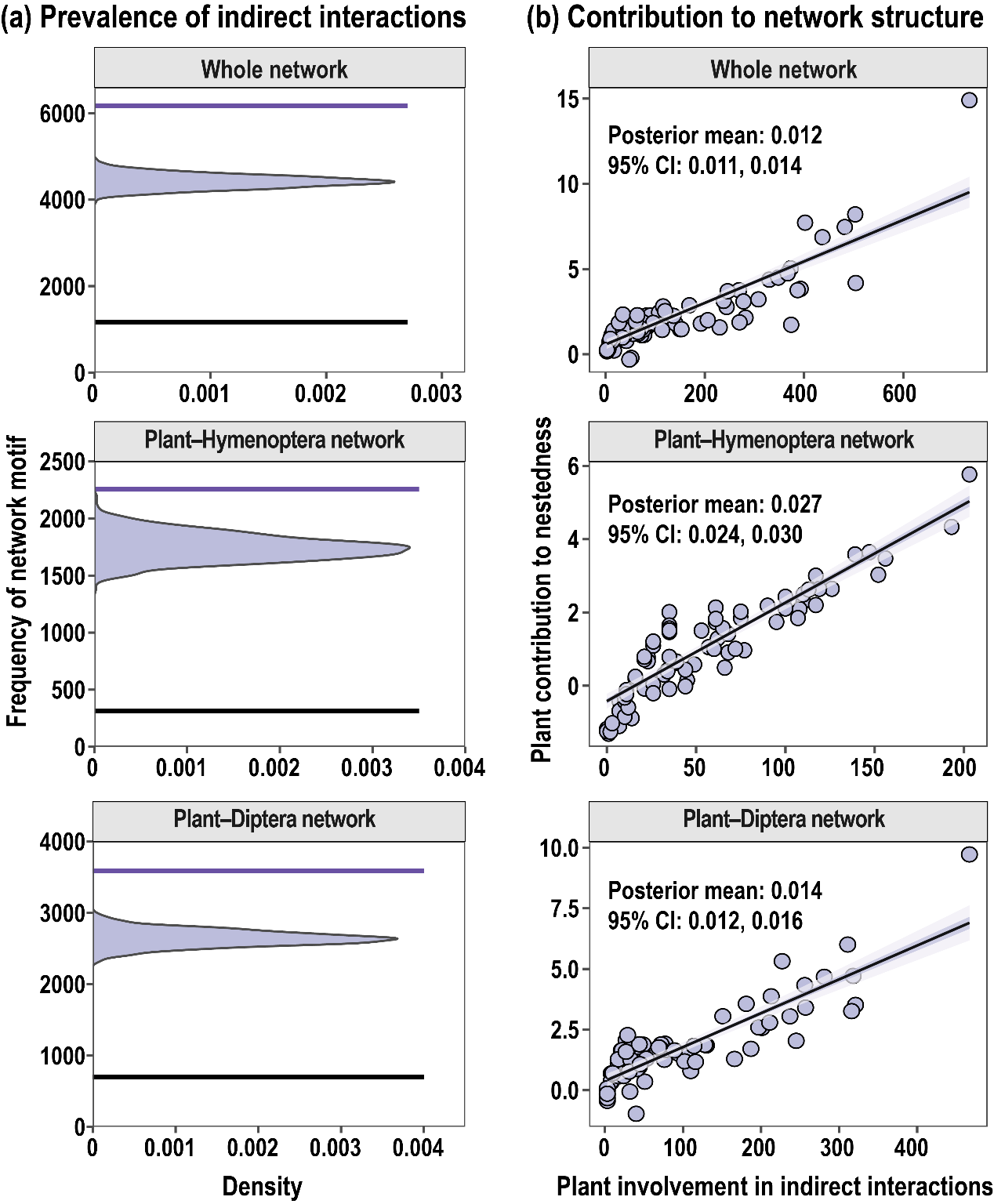
The prevalence of pollinator-mediated plant-plant indirect interactions in pollination networks and their contribution to network structure. (Image by WBG)
<関連情報>
- https://english.cas.cn/newsroom/research_news/life/202510/t20251022_1089987.shtml
- https://besjournals.onlinelibrary.wiley.com/doi/10.1111/1365-2745.70184
植物間の間接的な相互作用の背後にあるメカニズムの解明:中立的プロセスとニッチに基づくプロセスの影響 Disentangling the mechanisms behind indirect interactions between plants via shared pollinators: Effects of neutral and niche-based processes
Yong-Deng He, Amparo Lázaro, Pedro J. Bergamo, Huan Liang, Chun-Feng Yang, Zhong-Ming Ye
Journal of Ecology Published: 15 October 2025
DOI:https://doi.org/10.1111/1365-2745.70184
Abstract
- Indirect interactions between plants via shared pollinators play a crucial role in structuring and stabilizing ecological communities. Although both neutral (interactions occurring in proportion to species abundance) and niche-based (involving morphological matching and phenological overlap) processes are known to structure plant–pollinator interactions, how these processes drive the formation and maintenance of indirect interactions between plants in pollination networks remains poorly understood.
- Here, we investigated a species-rich alpine meadow in southwest China to disentangle the potential mechanisms underlying indirect interactions between plants via shared pollinators. We analysed data from the plant–Hymenoptera network, the plant–Diptera network and the whole network combining all plants and pollinators to (1) quantify the prevalence of indirect interactions between plants and their contribution to network structure; (2) assess how plant traits related to neutral (flower abundance) and niche-based (flower phenology, morphology and phylogeny) processes influence indirect interactions between plants; (3) evaluate the extent to which indirect interactions between plants could be predicted by neutral and niche-based processes.
- We found that indirect interactions between plants were highly prevalent across all networks and were related to increased contribution to nestedness, an important structure for network stability and the maintenance of species diversity. Corolla-tube length dissimilarity was the primary driver of the probability of indirect interactions between plants in both the whole network and the plant–Hymenoptera network, while flowering length had the greatest influence in the plant–Diptera network. Across all networks, flower abundance emerged as the key factor determining the strength of these interactions. Moreover, neutral and niche-based processes effectively predicted indirect interactions between plants, with neutral processes showing stronger predictive performance than the others.
- Synthesis. Overall, our study quantifies the prevalence of indirect interactions between plants in pollination networks and their influence on network structure and systematically elucidates the potential mechanisms underlying these interactions. These findings offer new insights into the ecological processes that govern species coexistence and contribute to the maintenance of biodiversity in plant–pollinator communities.