2025-10-24 中山大学 (SYSU)
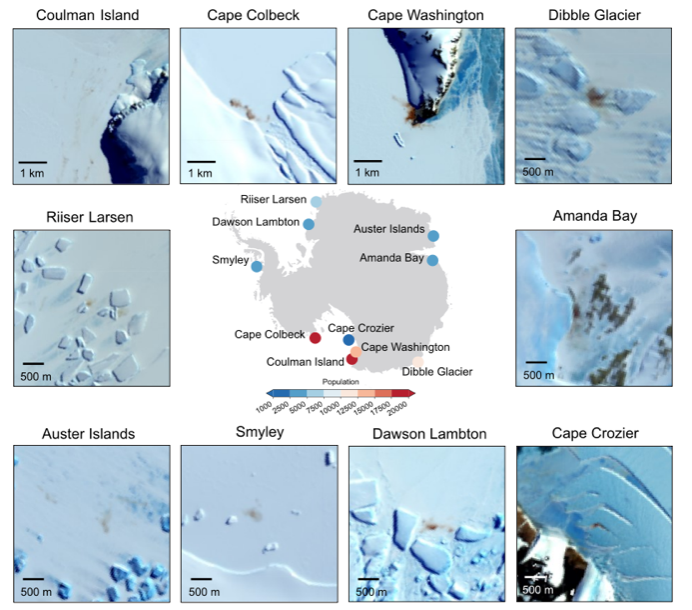
Distribution of 10 key emperor penguin colonies as seen in satellite imagery
<関連情報>
- https://www.sysu.edu.cn/sysuen/info/1012/57561.htm
- https://www.sciencedirect.com/science/article/abs/pii/S0034425725003888
極端な気候条件下における皇帝ペンギンの生息地分散の衛星マッピング Satellite mapping of emperor penguin habitat dispersal under climate extremes
Hong Lin, Xiao Cheng, Jinyang Du, John S. Kimball, Ziyu Yan, Teng Li, Tongwen Li, Yibo Li, Zilong Chen
Remote Sensing of Environment Available online: 22 August 2025
DOI:https://doi.org/10.1016/j.rse.2025.114984
Highlights
- Guano indices effectively distinguish emperor penguin colonies from the background.
- The proposed method enables long-term monitoring of emperor penguin habitats.
- Extreme climate events increase habitat dispersal and reduce habitat reuse duration.
- Clean-energy scenarios can reduce future fragmentation of emperor penguin habitats.
Abstract
Emperor penguins serve as early-warning sentinels for the Antarctic ecosystem and climate change. Understanding how climate change influences their habitat use offers insights into the fragile polar ecosystem for supporting the climate actions under the United Nations Sustainable Development Goals (SDGs). However, it remains unclear how the gradual climate change and extreme climatic events affect the dispersal of emperor penguin breeding habitats due to the lack of a systematic and long-term dataset documenting their habitat use. Here, we first develop guano indices and present an automated approach to map emperor penguin breeding habitats at 30-m spatial resolution using Earth observation satellite imagery, achieving a user accuracy of 94.8 %. We further reveal that habitat dispersal is sensitive to four extreme events—heat, blizzard, storm, and low sea ice. Specifically, colonies exposed to intense climate extremes generally exhibit more fragmented distributions, with habitat reuse periods mostly under 3 years and interannual habitat dispersal exceeding 4 km. These four extreme events together explained 21 %–72 % of the variability in annual habitat dispersal. Under a high-emission scenario driven by fossil fuels, the warming-induced annual fragmentation of habitats is projected to be 255 m greater than that under a low-emission scenario using clean energy, leading to higher vulnerability in emperor penguins by disrupting their ability to survive and reproduce. The proposed method enables routine mapping and updating of emperor penguin breeding habitats, and the associated findings demonstrate that extreme climatic events significantly impact habitat use and dispersal patterns, highlighting the urgent need for global climate policies aligned with sustainable development to protect the Antarctic ecosystem.