2025-10-29 東京科学大学
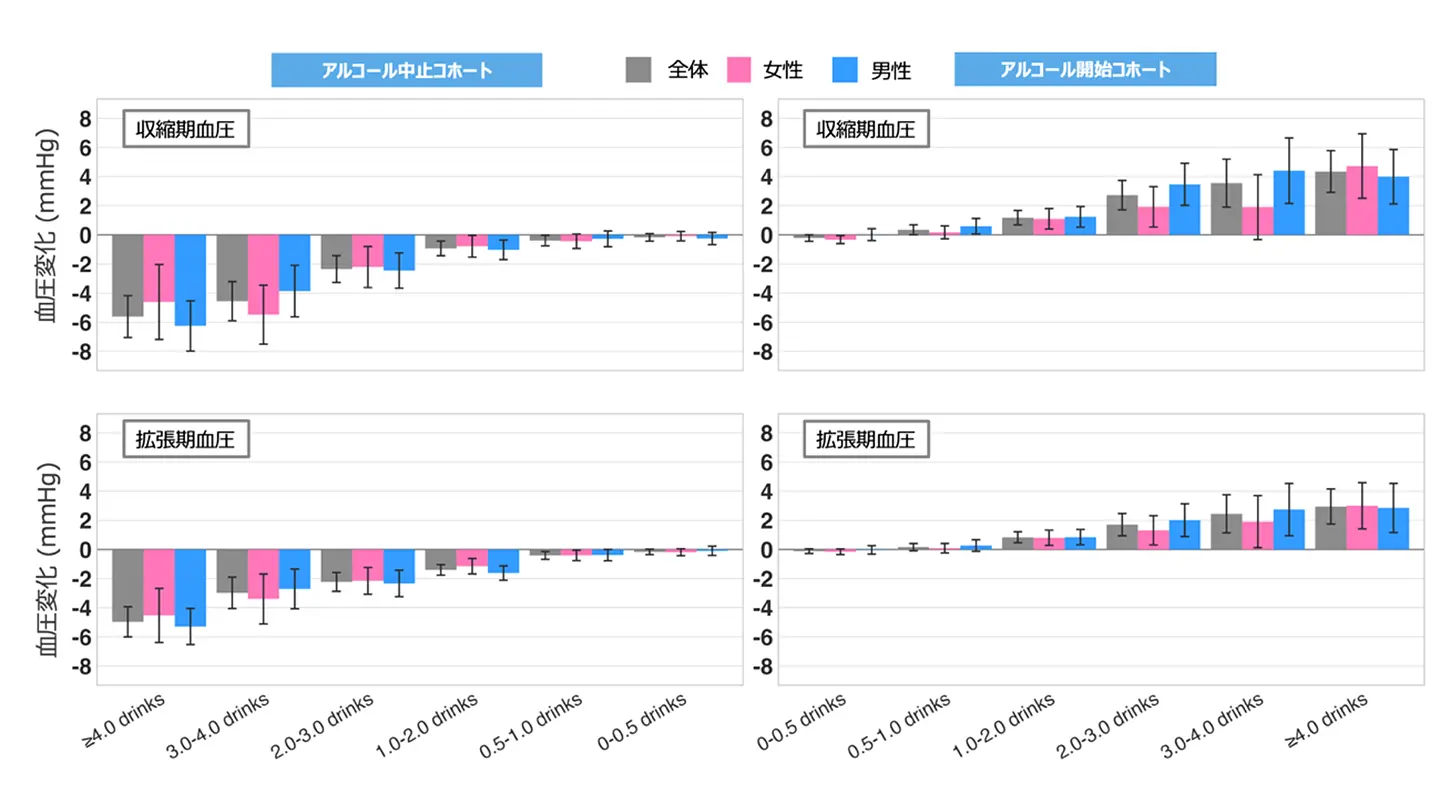
図1. アルコール摂取の中止または開始後における血圧の用量依存的変化
<関連情報>
女性と男性における軽度から中等度のアルコール摂取量の変化後の血圧:日本の年次健康診断の縦断的分析 Blood Pressure After Changes in Light-to-Moderate Alcohol Consumption in Women and Men: Longitudinal Japanese Annual Checkup Analysis
Takahiro Suzuki, Sho Fukui, Daisuke Yoneoka, Jiro Aoki, and Takeo Fujiwara
Journal of the American College of Cardiology Published:22 October 2025
DOI:https://doi.org/10.1016/j.jacc.2025.09.018
Abstract
Background
Alcohol consumption is a known contributor to elevated blood pressure (BP). However, the association between changes in light-to-moderate alcohol consumption (eg, ≤1 drink for women and ≤2 drinks for men daily), especially cessation, and BP remains unclear.
Objective
In this study, the authors sought to evaluate the associations between alcohol cessation/initiation and subsequent BP changes, focusing on sex-specific estimates, light-to-moderate intake, and type of alcoholic beverage.
Methods
We analyzed data from adults undergoing annual health checkups at a Japanese preventive medicine center from October 2012 to March 2024. Systolic blood pressure (SBP) and diastolic blood pressure (DBP) changes between consecutive visits were evaluated. Alcohol intake was self-reported as standard drinks (1 drink = 10 g ethanol). Associations between alcohol cessation/initiation and BP changes were assessed with the use of generalized estimating equations, adjusted for demographics, clinical history, and lifestyle behaviors.
Results
Among 359,717 visits from 58,943 participants, the cessation cohort (53,156 visits, 25,621 participants, median age 50.5 years, 52.1% women) revealed that cessation was associated with dose-dependent reductions in BP. Among women, cessation of 0.5 to 1.0 drinks per day did not correspond to a statistically significant change in SBP (-0.44 mm Hg; 95% CI: -0.93 to 0.06 mm Hg) and corresponded to a change of -0.41 mm Hg (95% CI: -0.77 to -0.05 mm Hg) in DBP, and cessation of 1.0 to 2.0 drinks per day corresponded to changes of -0.78 mm Hg (95% CI: -1.53 to -0.04 mm Hg) in SBP and -1.14 mm Hg (95% CI: -1.68 to -0.61 mm Hg) in DBP. Among men, cessation of 0.5 to 1.0 drinks per day did not correspond to a statistically significant change in SBP (-0.27 mm Hg; 95% CI: -0.81 to 0.27 mm Hg) or DBP (-0.39 mm Hg; 95% CI: -0.77 to 0.01 mm Hg), and cessation of 1.0 to 2.0 drinks per day corresponded to changes of -1.03 mm Hg (95% CI: -1.70 to -0.35 mm Hg) in SBP and -1.62 mm Hg (95% CI: -2.11 to -1.12 mm Hg) in DBP. The initiation cohort (128,552 visits, 31,532 participants, median age 50.0 years, 70.4% women) demonstrated dose-dependent increases in BP after alcohol initiation, and the overall direction of the effect was consistent across sexes. Beverage-specific analyses revealed similar BP effects regardless of alcohol type in both cohorts.
Conclusions
Even at low levels, drinking was associated with higher BP, and cessation was associated with lower BP in both sexes. These findings suggest that alcohol cessation is a broadly applicable strategy even among light-to-moderate drinkers for BP management. In this large dataset, BP changes in women associated with consumption at levels as low at 0.5 to 1 drinks per day are detectable.