2025-10-30 ロックフェラー大学
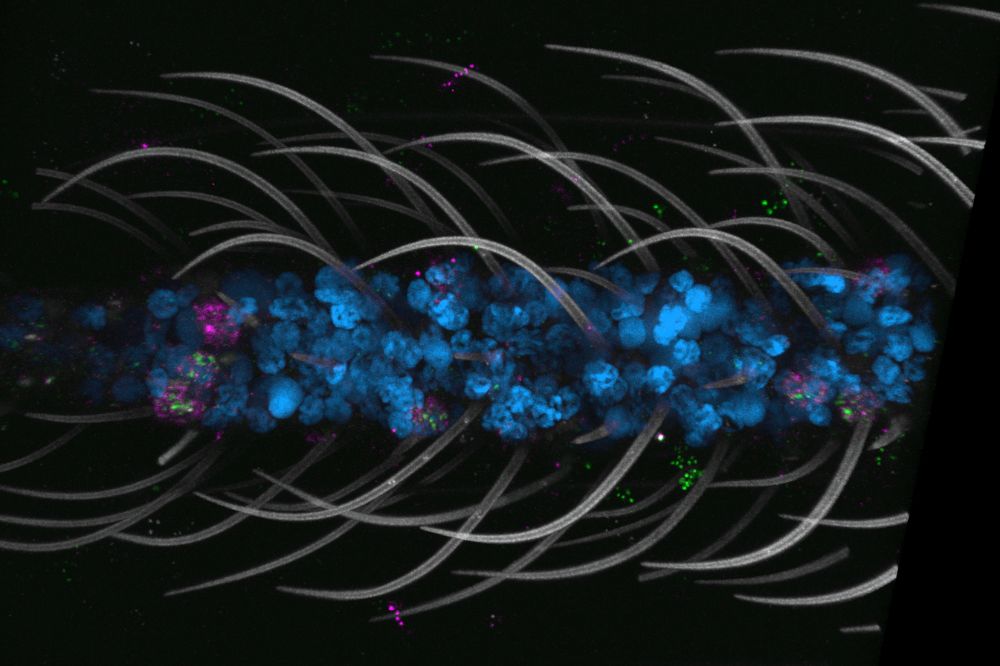
Confocal image of a male mosquito antenna, used to validate a unique chemoreceptor co-expression pattern identified in the mosquito atlas. (Credit: Alexandra DeFoe)
<関連情報>
- https://www.rockefeller.edu/news/38521-researchers-release-the-worlds-first-head-to-toe-cellular-atlas-of-the-mosquito/
- https://www.cell.com/cell/fulltext/S0092-8674(25)01137-7
ネッタイシマカ成虫の単核トランスクリプトームアトラス A single-nucleus transcriptomic atlas of the adult Aedes aegypti mosquito
Olivia V. Goldman ∙ Alexandra E. DeFoe ∙ Yanyan Qi ∙ … ∙ Hongjie Li ∙ Leslie B. Vosshall ∙ Nadav Shai
Cell Published:October 30, 2025
DOI:https://doi.org/10.1016/j.cell.2025.10.008
Highlights
- snRNA-seq atlas (>367,000 nuclei) from 19 male and female Aedes aegypti mosquito tissues
- Or82 and ppk317 cells show sex-specific expression in the antenna
- Appendage sensory neurons co-express genes from multiple chemosensory receptor families
- Glia, not neurons, show the most dramatic transcriptional changes in the brain after blood feeding
Summary
The female Aedes aegypti mosquito’s remarkable ability to hunt humans and transmit pathogens relies on her unique biology. Here, we present the Aedes aegypti Mosquito Cell Atlas, a comprehensive single-nucleus RNA sequencing dataset of more than 367,000 nuclei from 19 dissected tissues of adult female and male Aedes aegypti, providing cellular-level resolution of mosquito biology. We identify novel cell types and expand our understanding of sensory neuron organization of chemoreceptors across all sensory tissues. Our analysis uncovers male-specific cells and sexually dimorphic gene expression in the antenna and brain. In female mosquitoes, we find that glial cells, rather than neurons, undergo the most extensive transcriptional changes in the brain following blood feeding. Our findings provide insights into the cellular basis of mosquito behavior and sexual dimorphism. The Aedes aegypti Mosquito Cell Atlas resource enables systematic investigation of cell-type-specific expression across all mosquito tissues.