2025-11-10 エディンバラ大学
<関連情報>
- https://www.ed.ac.uk/news/dark-genome-holds-clues-to-neanderthal-face-shape
- https://journals.biologists.com/dev/article/152/21/dev204779/369721/Neanderthal-derived-variants-increase-SOX9
ネアンデルタール人由来の変異体は、顎の発達を形作る頭蓋顔面前駆細胞における SOX9エンハンサー活性を増加させる Neanderthal-derived variants increase SOX9 enhancer activity in craniofacial progenitors that shape jaw development
Kirsty Uttley,Hannah J. Jüllig,Carlo De Angelis,Julia M. T. Auer,Ewa Ozga,Hemant Bengani,Hannah K. Long
Development Published:10 November 2025
DOI:https://doi.org/10.1242/dev.204779
ABSTRACT
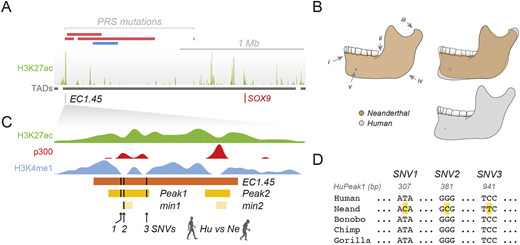
Human facial appearance is a highly variable morphological trait, with both rare and common genetic variants shaping craniofacial morphology between individuals and in disease. Deletions encompassing an enhancer cluster 1.45 megabases upstream of SOX9 (EC1.45) cause Pierre Robin sequence, a craniofacial disorder characterised by underdevelopment of the lower jaw and associated with cleft palate. We hypothesised therefore that single nucleotide variants within EC1.45 may cause more subtle alterations in facial form. Leveraging recent human evolution, and the distinct jaw morphology of Neanderthals, we investigated the impact of three Neanderthal-derived variants on EC1.45 function. Using zebrafish dual enhancer-reporters, we observed higher activity of Neanderthal EC1.45 in neural crest-derived progenitor cells during a specific developmental window. These EC1.45-active cells reside proximal to and are transcriptionally related to precartilaginous condensations that contribute to craniofacial skeletal development. Mimicking the observed increase in enhancer activity, we overexpressed human SOX9 in EC1.45-active cells and detected an expanded volume of developing cartilaginous precursors. Our work implicates Neanderthal-derived variants in increasing regulatory activity for a disease-associated enhancer, with the potential to impact craniofacial morphology across recent hominin evolution.