
2025-11-11 ペンシルベニア州立大学 (PennState)
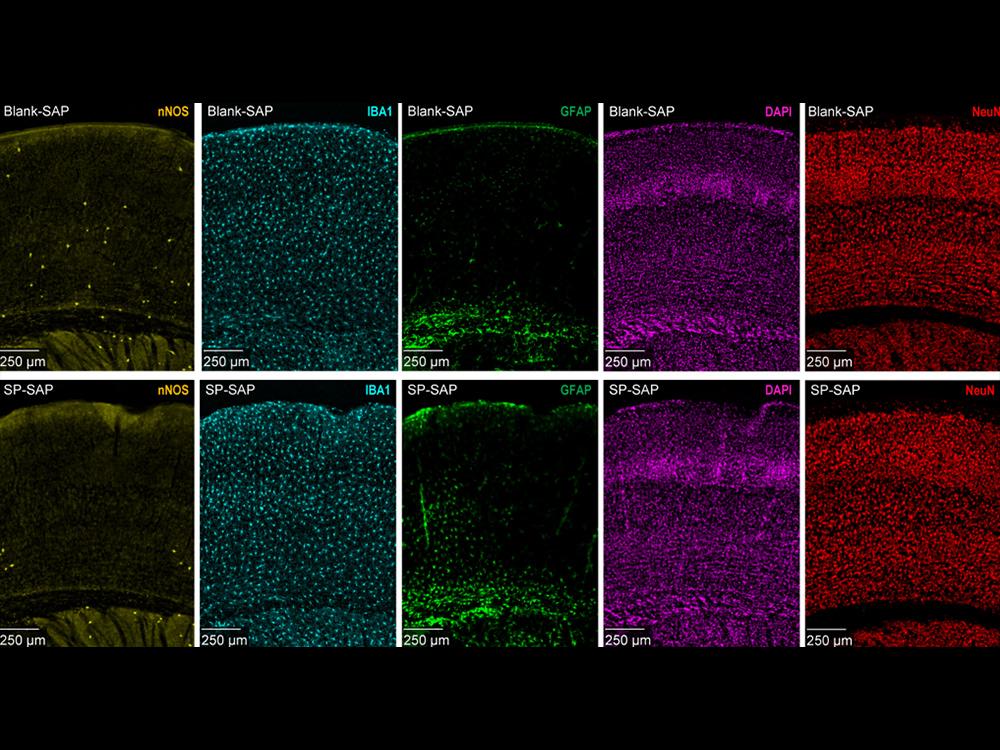
The type of neuron the team targeted, type-one nNOS, which is colored yellow in the figure above, is rare compared to other neurons in the brain. By using the injection method, the team was able to systematically eliminate these neurons from the brain, providing insight into the role they play. Credit: Provided by Patrick Drew. All Rights Reserved.
<関連情報>
- https://www.psu.edu/news/engineering/story/its-not-just-your-head-stress-may-lead-altered-blood-flow-brain
- https://elifesciences.org/articles/105649
- https://elifesciences.org/articles/60533
I型nNOSニューロンは皮質神経活動と血管運動を調整する Type-I nNOS neurons orchestrate cortical neural activity and vasomotion
Kevin Turner,Dakota Brockway,Md Shakhawat Hossain,Keith Griffith,Denver Greenawalt,Qingguang Zhang,Kyle Gheres,Nicole Crowley,Patrick J Drew
eLife Published:Nov 11, 2025
DOI:https://doi.org/10.7554/eLife.105649.3
Abstract
It is unknown how the brain orchestrates coordination of global neural and vascular dynamics. We sought to uncover the role of a sparse but unusual population of genetically distinct interneurons known as type-I nNOS neurons, using a novel pharmacological strategy to unilaterally ablate these neurons from the somatosensory cortex of mice. Region-specific ablation produced changes in both neural activity and vascular dynamics, decreased power in the delta-band of the local field potential, reduced sustained vascular responses to prolonged sensory stimulation, and abolished the post-stimulus undershoot in cerebral blood volume. Coherence between the left and right somatosensory cortex gamma-band power envelope and blood volume at ultra-low frequencies was decreased, suggesting type-1 nNOS neurons integrate long-range coordination of brain signals. Lastly, we observed decreases in the amplitude of resting-state blood volume oscillations and decreased vasomotion following the ablation of type-I nNOS neurons. This demonstrates that a small population of nNOS-positive neurons is indispensable for regulating both neural and vascular dynamics in the whole brain, raising the possibility that loss of these neurons could contribute to the development of neurodegenerative diseases and sleep disturbances.
nNOS発現介在ニューロンはマウスの体性感覚皮質における基礎的および行動誘発性動脈拡張を制御する nNOS-expressing interneurons control basal and behaviorally evoked arterial dilation in somatosensory cortex of mice
Christina T Echagarruga,Kyle W Gheres,Jordan N Norwood,Patrick J Drew
eLife Published:Oct 5, 2020
DOI:https://doi.org/10.7554/eLife.60533
Abstract
Cortical neural activity is coupled to local arterial diameter and blood flow. However, which neurons control the dynamics of cerebral arteries is not well understood. We dissected the cellular mechanisms controlling the basal diameter and evoked dilation in cortical arteries in awake, head-fixed mice. Locomotion drove robust arterial dilation, increases in gamma band power in the local field potential (LFP), and increases calcium signals in pyramidal and neuronal nitric oxide synthase (nNOS)-expressing neurons. Chemogenetic or pharmocological modulation of overall neural activity up or down caused corresponding increases or decreases in basal arterial diameter. Modulation of pyramidal neuron activity alone had little effect on basal or evoked arterial dilation, despite pronounced changes in the LFP. Modulation of the activity of nNOS-expressing neurons drove changes in the basal and evoked arterial diameter without corresponding changes in population neural activity.

