2025-11-25 ミュンヘン大学(LMU)
<関連情報>
- https://www.lmu.de/en/newsroom/news-overview/news/nasal-microbiome-resource-scarcity-as-opportunity.html
- https://academic.oup.com/ismej/article/19/1/wraf248/8314006
黄色ブドウ球菌 の鼻腔常在菌に対する競争力はビオチンの生合成と獲得に依存する Competitive fitness of Staphylococcus aureus against nasal commensals depends on biotin biosynthesis and acquisition
Kevser Bilici, David Gerlach, Laura Camus, Simon Heilbronner
The ISME Journal Published:04 November 2025
DOI:https://doi.org/10.1093/ismejo/wraf248
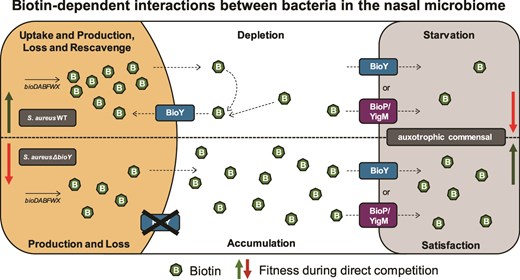
Graphical Abstract
Abstract
The human nasal microbiome can serve as a reservoir for pathogens. In particular, the opportunistic pathogen Staphylococcus aureus can be a member of the nasal microbiome increasing the risk of subsequent infections. The nasal carriage of S. aureus is known to be positively and negatively impacted by nonpathogenic species, suggesting interactions between the pathogen and commensals, but the underlying molecular mechanism remains largely unclear. Herein we demonstrate that S. aureus competes with nasal commensals for the coenzyme biotin. Biotin is crucial for all living organisms and we show that depletion of biotin impairs S. aureus growth and membrane integrity. We found the nasal cavity to be a biotin-limited environment, suggesting competition for the coenzyme within the microbiome. For some nasal commensals and S. aureus, we observed biotin prototrophy and all strains released biotin into the environment. In contrast, other commensals and especially coagulase-negative staphylococci (CoNS) were found to be biotin auxotrophs and strongly reliant on prototrophic strains under biotin-limited conditions. We show that high-affinity biotin uptake systems are used by prototrophic and auxotrophic strains alike and represent crucial factors to optimize competitive fitness of species in co-culture. Together, our data show that biotin-mediated interactions occur between the species of the human nasal microbiome and provide evidence for interspecies competition and co-dependency.